
Single-Mode Fiber vs Multimode Fiber: A Simple Guide to Choosing the Right Transceiver
2026-09-13 17:18:23
Single-Mode Fiber vs Multimode Fiber: What’s the Difference?
When choosing an optical transceiver, many buyers focus first on speed and transmission distance.
But there is another important question:
What type of fiber will the transceiver run over?
The two main types used in fiber-optic networks are Single-Mode Fiber (SMF) and Multimode Fiber (MMF).
Choosing the wrong combination of fiber and transceiver can lead to poor link performance, compatibility issues, or unexpected optical loss.
This guide explains the difference in simple terms.
What Is Single-Mode Fiber (SMF)?
Single-Mode Fiber (SMF) has a much smaller fiber core, typically around 9 μm.
It is designed to carry a single mode of light, allowing signals to travel much farther with relatively low modal dispersion.
SMF is commonly used for:
Data center interconnects
Campus networks
Telecom networks
Long-distance Ethernet links
Data center spine-to-spine connections
10G, 25G, 100G and higher-speed long-reach applications
Common wavelengths include 1310 nm and 1550 nm.
Typical transceiver examples include:
10G LR / ER
25G LR
100G LR / ER
400G LR / FR / ZR-class solutions
The exact reach depends on the transceiver specification, fiber quality, connectors, and overall link budget.
What Is Multimode Fiber (MMF)?
Multimode Fiber (MMF) has a much larger core than SMF.
Common MMF sizes include:
50/125 μm
62.5/125 μm
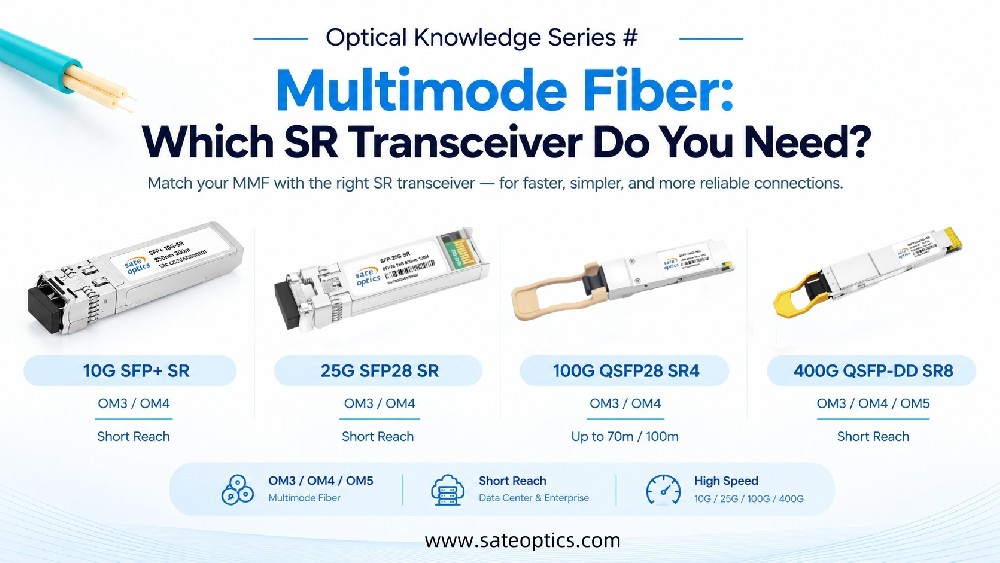
Modern data center MMF is commonly associated with OM3, OM4 and OM5 fiber.
MMF is mainly used for shorter-distance connections because multiple modes of light travel through the fiber.
The most common wavelength for modern MMF Ethernet transceivers is 850 nm.
For example:
10G SR → 850 nm MMF
25G SR → 850 nm MMF
100G SR → 850 nm MMF
Older multimode systems can also use 1300 nm, but 850 nm is the key wavelength to remember when selecting modern short-reach MMF transceivers.
SMF vs MMF: Quick Comparison
| Single-Mode Fiber | Multimode Fiber | |
|---|---|---|
| Core size | ~9 μm | 50/125 or 62.5/125 μm |
| Common wavelength | 1310 / 1550 nm | 850 nm |
| Typical application | Longer distance | Shorter distance |
| Common transceiver | LR / ER / ZR | SR |
| Typical environment | DCI, campus, telecom, long links | Data center, server-room links |
The important point is:
SMF and MMF are not interchangeable simply because the connectors look the same.
Does Fiber Type Affect Transceiver Selection?
Yes.
A transceiver is designed for a particular optical interface, wavelength, reach and fiber type.
For example:
10G SFP+ SR
→ 850 nm
→ Multimode Fiber
10G SFP+ LR
→ 1310 nm
→ Single-Mode Fiber
So the same 10G network speed can require completely different optical solutions depending on the fiber infrastructure.
A Simple Rule for Network Planning
Think of it this way:
Short distance → MMF + SR
Longer distance → SMF + LR / ER / ZR
But distance should not be the only consideration.
Before ordering an optical transceiver, check:
① Network speed
② Transmission distance
③ Fiber type
④ Wavelength
⑤ Connector type
⑥ Link budget
⑦ Equipment compatibility
This simple checklist can prevent many avoidable optical-link problems.
Why This Matters When Buying Optical Transceivers
A common mistake is to choose a transceiver based only on:
“I need 10G.”
But 10G SR and 10G LR are very different solutions.
The correct choice depends on the entire link.
For example:
Switch → Server, short distance
→ 10G SR + MMF
Switch → Switch, longer distance
→ 10G LR + SMF
For higher-speed networks, the same principle applies. As network speeds move from 25G and 100G to 400G and 800G, fiber type, reach, optical budget and transceiver design become increasingly important.
Frequently Asked Questions
Can I use an SR transceiver with Single-Mode Fiber?
Generally, SR transceivers are designed for multimode fiber, so they should not be treated as a standard SMF solution. Always check the transceiver specification before deployment.
Can I use an LR transceiver with Multimode Fiber?
An LR transceiver is normally designed for single-mode fiber. Using it with MMF is not the standard deployment approach and may result in an unsuitable optical link.
Is 1300 nm used with multimode fiber?
Yes. 1300 nm has been used in some legacy multimode systems, but modern Ethernet MMF applications commonly use 850 nm, particularly with SR transceivers.
Which is better, SMF or MMF?
Neither is universally better.
MMF is often a practical choice for shorter links, while SMF is preferred when longer reach is required.
The right choice depends on the application.
Choosing the Right Optical Transceiver
At Sate Optics, optical transceivers are available for a wide range of network speeds, distances and equipment platforms.
Solutions include compatible SFP, SFP+, SFP28, QSFP+, QSFP28, QSFP-DD and OSFP transceivers for different network applications.
Each compatible module can be coded and tested for the target equipment before shipment, helping customers deploy with greater confidence.
For help selecting the right transceiver, provide your:
Switch model + speed + distance + fiber type
and the optical solution can be matched to the actual network application.
Learn more about optical transceiver solutions at www.sateoptics.com.
Previous:Original vs Compatible Optical Transceivers: What Matters? | Sate Optics
Next:AI Data Center Networking: 400G & 800G Optical Transceivers