
Multimode Fiber and SR Transceivers: How to Choose the Right Combination
2026-09-16 22:26:57
Multimode Fiber and SR Transceivers: How to Choose the Right Combination
Multimode fiber (MMF) remains an important choice for short-reach connections in data centers, enterprise networks, and high-density server environments.
But choosing MMF is only part of the decision.
The transceiver must also match the network speed, transmission distance, fiber type, connector, and application.
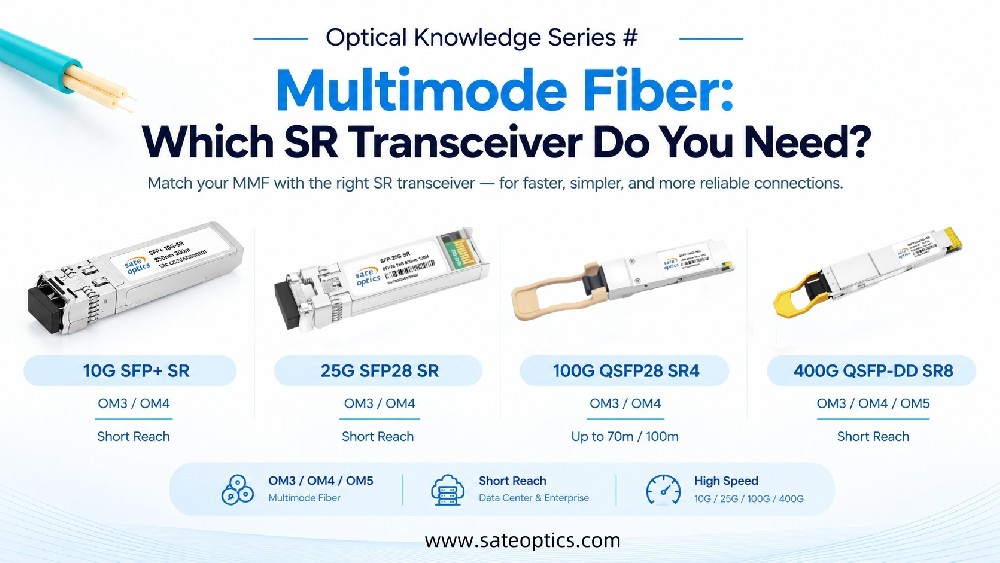
For example, a 10G SFP+ SR, 25G SFP28 SR, 100G QSFP28 SR4, and 400G QSFP-DD SR8 may all be used for short-reach applications, but they are designed for different network architectures and reach requirements.
So the better question is not:
“Which multimode fiber should I use?”
It is:
“Which SR transceiver is the right match for my MMF link?”
What Is Multimode Fiber?
Multimode fiber is an optical fiber designed to carry multiple modes of light through a relatively large core.
In modern data center networks, OM3, OM4, and OM5 are common types of 50/125 μm multimode fiber.
They are widely associated with short-reach, high-speed optical transmission using VCSEL-based transceivers, particularly around the 850nm wavelength.
The main advantage of MMF is its suitability for relatively short links where high bandwidth, practical deployment, and cost efficiency are important.
That makes it especially useful for connections such as:
Server to switch
Switch to switch
Rack to rack
Leaf to spine
Data center cross-connects
Enterprise network uplinks
MMF + SR Transceiver: A Quick Reference
The following combinations cover several common short-reach Ethernet applications.
| Network Speed | Typical SR Transceiver | Fiber | Typical Reach* |
|---|---|---|---|
| 10G | SFP+ SR | OM3 / OM4 / OM5 | Up to 300–400m |
| 25G | SFP28 SR | OM3 / OM4 | Up to 70–100m |
| 100G | QSFP28 SR4 | OM3 / OM4 | Up to 70–100m |
| 400G | QSFP-DD SR8 | OM3 / OM4 | Up to 70–100m |
*Actual supported distance depends on the specific transceiver, fiber grade, connector loss, and link design.
For example, Cisco specifies 25G SR at 70m over OM3 and 100m over OM4, while 100G SR4 is specified at 70m over OM3 and 100m over OM4.
Corning's technical guidance similarly lists 25G SR and 400G SR8 at 70m on OM3 and 100m on OM4.
1. 10G SFP+ SR
10G SFP+ SR is one of the most widely deployed short-reach optical transceivers.
It typically operates at 850nm over multimode fiber and is commonly used for:
Server-to-switch connections
Data center access networks
Enterprise switches
Short switch-to-switch links
Depending on the fiber and transceiver specification, 10GBASE-SR can support approximately 300m on OM3 and 400m on OM4/OM5.
Best suited for:
10G networks where the link is short enough for multimode fiber and SR optics.
For many existing data center networks, 10G SR remains a practical solution where upgrading the entire network to a higher speed is not yet necessary.
2. 25G SFP28 SR
For networks moving beyond 10G, 25G SFP28 SR provides a higher-speed option while maintaining the compact SFP form factor.
A typical 25G SR transceiver operates at 850nm over MMF.
For example, 25G SR is commonly specified for:
70m over OM3
100m over OM4
Cisco lists these distances for its 25G SFP28 SR module.
Sate Optics also offers a 25G SFP28 SR with 850nm optics, duplex LC connectivity, MMF support, and a 100m reach specification.
Best suited for:
25G server-to-switch connections
Data center access networks
High-density server deployments
10G-to-25G network upgrades
3. 100G QSFP28 SR4
When the network moves to 100G, the 100G QSFP28 SR4 is a common short-reach MMF solution.
It uses parallel optical lanes and is typically based on 850nm VCSEL technology.
A standard 100G SR4 configuration can support:
70m over OM3
100m over OM4
Cisco's current 100G QSFP documentation lists these distances for 100G SR4 over MMF.
Sate Optics' ST-100G-QSFP28-SR4 is specified for 100G, 850nm, MTP/MPO connectivity, MMF, and up to 100m.
Best suited for:
Leaf-to-spine connections
Switch-to-switch links
Data center aggregation
100G server and network upgrades
Short-distance high-bandwidth links
4. 400G QSFP-DD SR8
At 400G, the architecture changes again.
The 400G QSFP-DD SR8 is designed for short-reach, high-density data center connectivity and uses multiple parallel optical lanes over multimode fiber.
A typical 400G SR8 implementation uses:
8 × 50G optical lanes → 400G
and a 16-fiber MPO/MTP interface.
Corning's technical data lists 400G SR8 at 70m over OM3 and 100m over OM4.
Sate Optics' ST-400G-QSFPDD-SR8 is specified at 400G, 850nm, with MTP/MPO-16 connectivity and MMF support for up to 100m.
Best suited for:
AI and high-performance data center networks
Leaf-to-spine connections
High-density switch interconnects
400G server and switch upgrades
Short-reach 400G links
OM3 vs OM4 vs OM5: Do You Always Need the Newest Fiber?
Not necessarily.
This is one of the most important points when selecting an MMF transceiver.
OM4 is not automatically the better choice for every network, and OM5 does not automatically provide a longer reach with every SR transceiver.
For conventional 850nm SR4 applications, OM4 can provide a longer reach than OM3.
However, the benefit of OM5 depends heavily on the transceiver technology being used. For example, Corning notes that for conventional SR4 transceivers operating solely at 850nm, OM5 does not provide a distance advantage over OM4 because both meet the relevant bandwidth specification at 850nm.
This is why the correct selection process should start with the transceiver, rather than simply choosing the newest fiber category.
How to Choose the Right SR Transceiver
A simple selection process is:
1. Start with network speed
Are you deploying:
10G → 25G → 100G → 400G?
The speed determines the transceiver family you need.
2. Check the actual link distance
Do not choose an SR transceiver simply because the link is “short.”
Measure the actual distance.
For example:
50m ≠ 100m ≠ 150m
The required reach should be checked against the transceiver's specification.
3. Identify the fiber type
Check whether the existing cabling is:
OM3 / OM4 / OM5
Do not assume that every SR module has the same reach on every MMF type.
4. Check the connector
This becomes especially important as network speeds increase.
Examples include:
Duplex LC
MPO/MTP-8
MPO/MTP-12
MPO/MTP-16
The connector and fiber count must match the transceiver and cabling architecture.
5. Check equipment compatibility
A technically correct SR module can still be the wrong choice if it is not supported by the switch, router, server, or NIC.
Before deployment, verify:
Transceiver coding → Device compatibility → Port speed → Fiber → Connector
This is particularly important when using third-party or compatible optical transceivers.
Common MMF Deployment Scenarios
Server → Switch
For short server connections, 10G SFP+ SR and 25G SFP28 SR are common choices.
The correct option depends mainly on the server NIC speed, switch port speed, and existing MMF cabling.
Switch → Switch
For higher bandwidth connections, 100G QSFP28 SR4 or 400G QSFP-DD SR8 can be used for short-reach data center interconnects.
The required fiber count and connector type should be checked before deployment.
Leaf → Spine
As data center architectures move toward 100G and 400G, parallel-fiber SR solutions can provide a practical option for short leaf-to-spine links.
This is especially relevant in high-density data center environments where many short optical links are deployed. Multimode fiber continues to be used for short-reach data center connectivity.
A Simple Rule to Remember
When choosing an MMF transceiver, don't start with:
“Which fiber is better?”
Start with:
“What speed and distance do I need?”
Then work through:
Speed → Distance → Fiber Type → Connector → Transceiver → Device Compatibility
This approach helps avoid selecting a transceiver based only on the highest available speed or the newest fiber category.
Sate Optics SR Transceiver Solutions
Sate Optics provides compatible optical transceivers for a range of short-reach networking applications, including 10G SFP+ SR, 25G SFP28 SR, 100G QSFP28 SR4, and 400G QSFP-DD SR8.
The company's portfolio covers data center, enterprise, cloud, and high-speed networking applications, with different form factors, speeds, fiber types, and reach options.
For compatible transceiver deployments, modules can be supplied according to the target networking platform and application requirements.
Before ordering, provide the device model, port speed, fiber type, connector type, and required distance. This makes it easier to identify the right transceiver for the link.
FAQ
Is multimode fiber only used for 10G networks?
No.
Multimode fiber is used across multiple generations of short-reach networking, including 10G, 25G, 40G, 100G and 400G applications.
What is the difference between an SR transceiver and an LR transceiver?
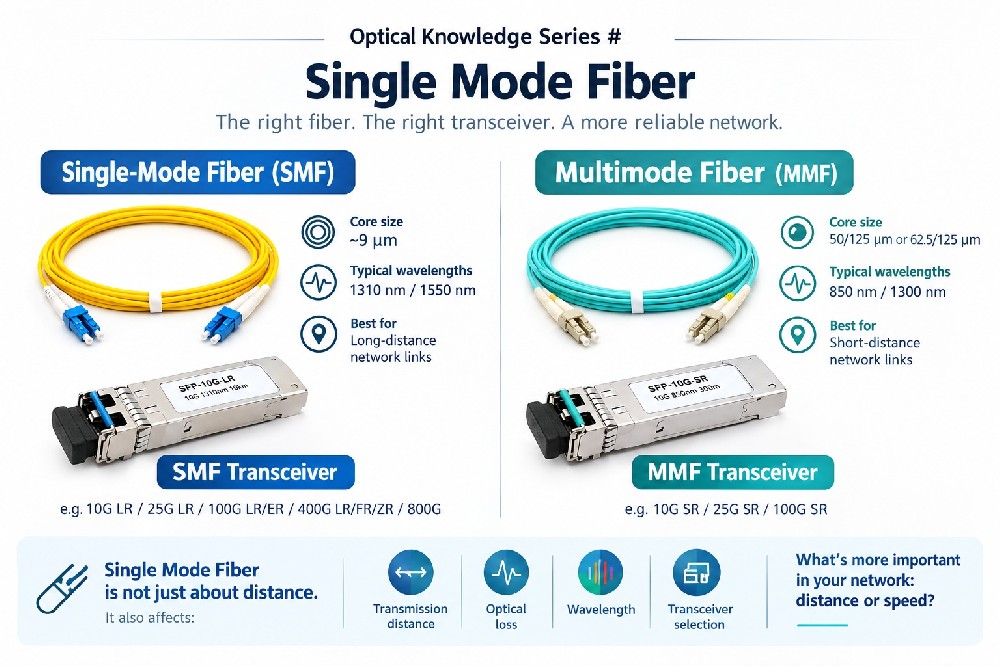
SR generally refers to short-reach optical transmission, commonly using multimode fiber and 850nm optics.
LR modules are generally designed for longer-distance transmission and typically use single-mode fiber, often around 1310nm.
The actual specifications depend on the transceiver standard and manufacturer.
Can I use OM4 instead of OM3?
In many short-reach applications, yes, but the supported distance should be checked against the specific transceiver specification.
For example, 25G SR and 100G SR4 commonly provide longer reach on OM4 than OM3.
Is OM5 always better than OM4?
No.
OM5 can be useful for specific multi-wavelength applications, but it does not automatically provide a reach advantage with every SR transceiver. For conventional 850nm SR4 applications, OM4 can provide the required reach without the need for OM5.
Can a third-party SR transceiver work in my switch?
A compatible transceiver can work when its optical and electrical specifications, coding, and device compatibility are correct.
However, compatibility should be checked against the specific switch, router, server, or NIC model rather than assuming that all SR modules work in all devices.
Which SR transceiver should I choose for 100m MMF?
It depends on the network speed.
For example:
10G → SFP+ SR
25G → SFP28 SR
100G → QSFP28 SR4
400G → QSFP-DD SR8
The final choice should also consider the MMF grade, connector, fiber count, and device compatibility.
Conclusion
Multimode fiber remains a practical solution for short-reach network connections, particularly in data center and enterprise environments.
The key is not simply choosing OM3, OM4, or OM5.
The better approach is to match the complete link:
Network Speed + Distance + Fiber + Connector + Transceiver + Device Compatibility
Whether the deployment is 10G, 25G, 100G, or 400G, choosing the right SR transceiver can help build a simpler and more reliable short-reach optical connection.
Looking for a compatible SR transceiver for your network?
Share your device model, port speed, fiber type, connector, and required distance with Sate Optics, and our team can help identify a suitable option for your application.
Explore Sate Optics 25G SFP28 Transceivers · Explore Sate Optics 100G QSFP28 Transceivers · Explore Sate Optics 400G QSFP-DD Transceivers
Previous:Loopback Testing: The Fastest Way to Find Network Link Problems?
Next:OFC 2026: The Industry Moves Toward 1.6T Optical Connectivity