
AI Data Center Networking: 400G & 800G Optical Transceivers
2026-09-15 22:14:34
AI Data Center Networking: Why Optical Connectivity Matters for GPU Clusters
AI data centers are not only about GPUs. They are also about moving data between them.
As AI workloads scale, the network connecting GPU servers becomes an increasingly important part of the infrastructure.
Modern AI clusters can involve large numbers of GPUs communicating across servers, network adapters, switches and high-speed optical links. NVIDIA's current AI networking architectures, for example, use 400G and 800G-class network connectivity for GPU cluster communication, while the industry is also moving toward 1.6T connectivity.
This creates a simple but important question for data center designers and network teams:
Can the network move the data that the compute infrastructure needs — reliably, efficiently and at the required scale?
That is where high-speed networking and optical connectivity become important.
AI Infrastructure Is More Than Compute
It is easy to think about AI infrastructure in terms of GPUs, servers and computing capacity.
But GPUs do not operate in isolation.
In a distributed AI cluster, compute nodes need to communicate with each other and with other parts of the infrastructure. Depending on the architecture, this can involve high-speed Ethernet or InfiniBand networking, NICs or SuperNICs, switches and optical interconnects.
A simplified view is:
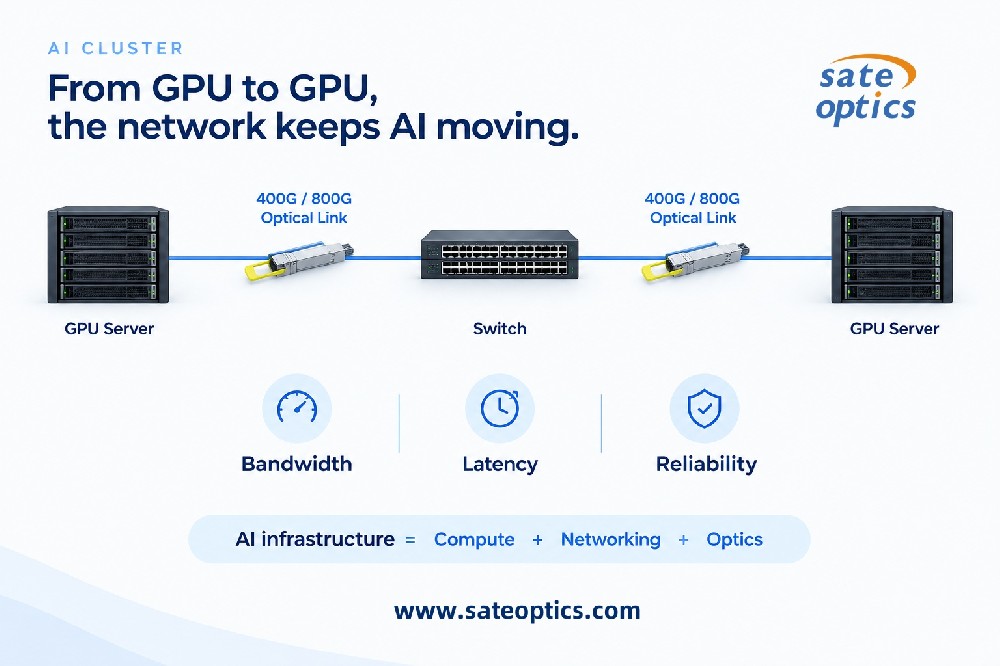
GPU Server → NIC / SuperNIC → Switch → Optical Link → Switch → NIC / SuperNIC → GPU Server
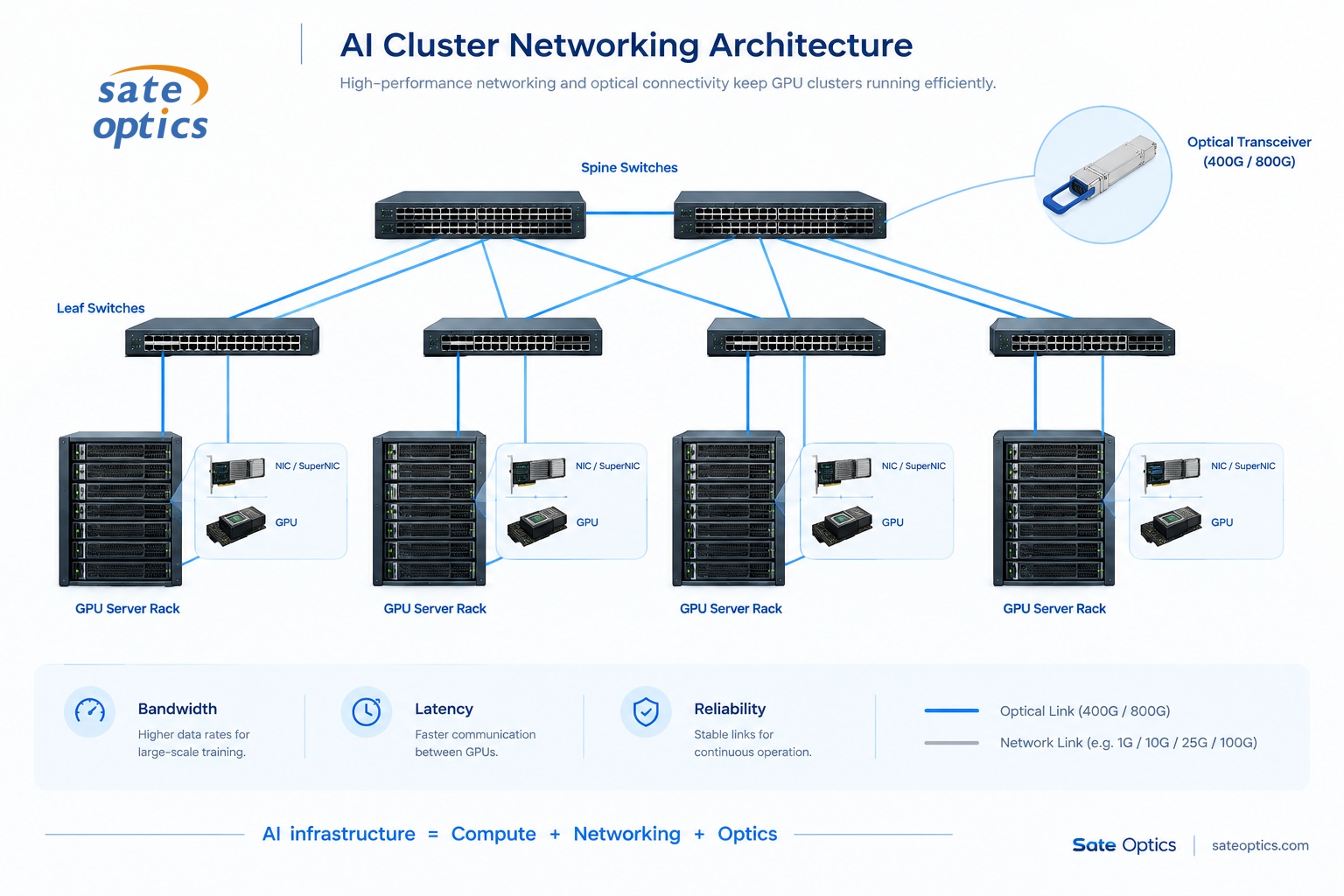
The exact architecture varies by platform, but the principle is the same:
Compute performance depends on a network that can keep data moving between compute resources.
NVIDIA's reference architectures distinguish between different network functions, including GPU cluster interconnects for east-west traffic and other networks for storage, management and external connectivity.
This is why network design has become an important part of AI data center planning.
Why Networking Matters in AI Clusters
AI workloads often involve distributed computation across multiple GPUs and servers.
When many compute resources need to exchange data, network performance can influence how efficiently the cluster operates.
The network therefore needs to provide more than high nominal bandwidth.
Important considerations include:
Bandwidth
Latency
Congestion management
Link reliability
Interoperability
Power consumption
Thermal management
Monitoring and diagnostics
For example, NVIDIA's current AI networking platforms combine high-speed switches, SuperNICs and optical interconnects to support large-scale AI fabrics. Its Spectrum-X platform is specifically designed around AI networking requirements such as congestion control, adaptive routing and network resiliency.
The takeaway is simple:
A high-speed GPU cluster also needs a network designed for high-speed GPU communication.
Where Optical Transceivers Fit
Optical transceivers are one of the physical components that connect high-speed network equipment over fiber.
In an AI data center, optical connectivity can be used for links such as:
Server / NIC ↔ Switch
and
Switch ↔ Switch
depending on the architecture.
At higher data rates, optical links become especially important when the required distance goes beyond what passive copper connections can practically support.
Current AI networking platforms include 400G and 800G optical transceivers and cables, with different form factors, reach options and host-side interfaces depending on the platform.
This means that selecting an optical transceiver should not start with:
“What is the highest speed available?”
A better question is:
“What does this specific link require?”
400G and 800G: Why the Speed Matters
400G and 800G are increasingly visible in high-performance data center and AI networking.
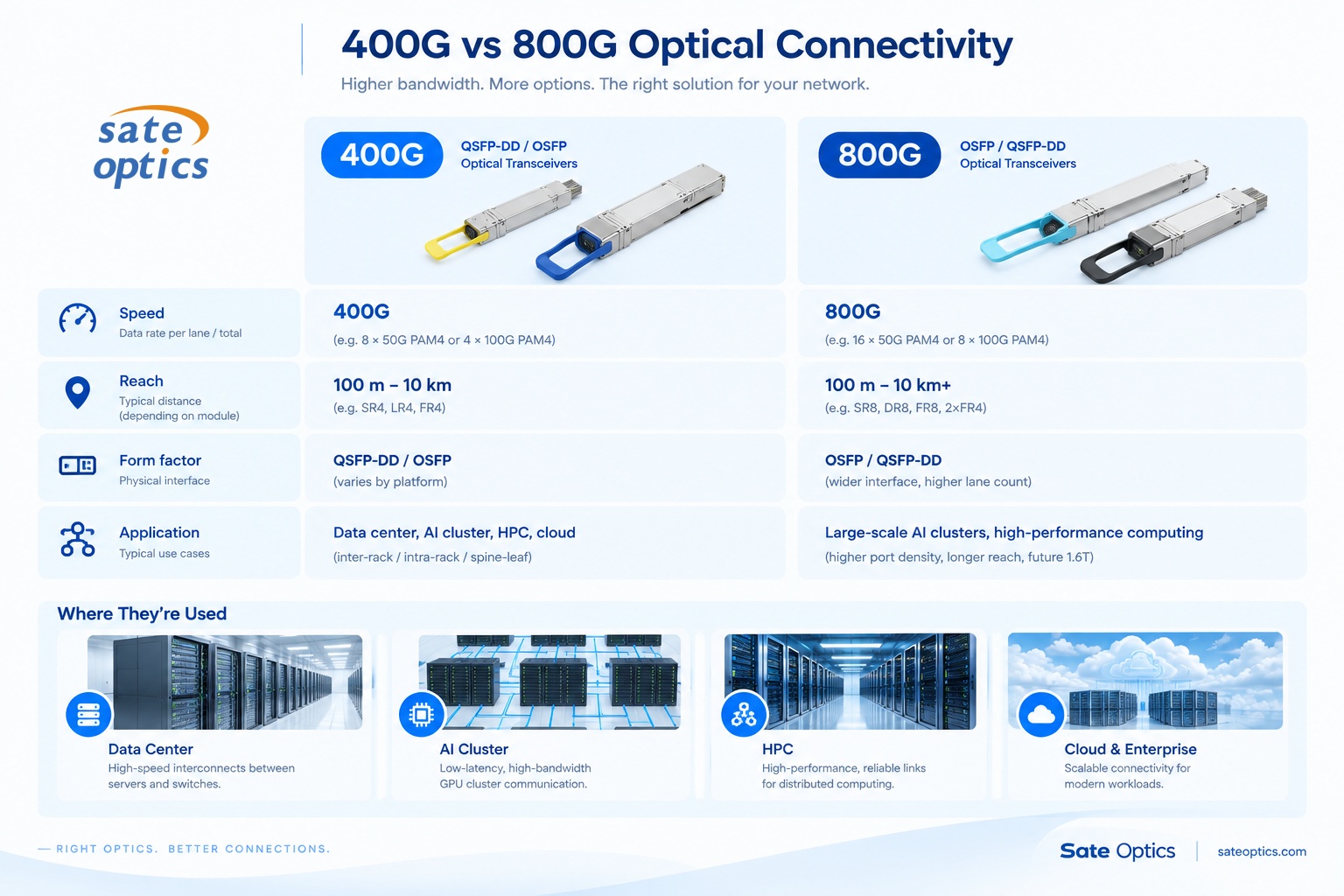
But these numbers describe the data rate of the interface. They do not, by themselves, tell you whether a particular optical module is suitable for a network.
For example, a 400G or 800G link still needs to be evaluated according to:
Required transmission distance
Fiber type
Connector type
Optical link budget
Switch and NIC compatibility
Power consumption
Operating temperature
Network protocol and platform requirements
Testing and monitoring capabilities
NVIDIA's current optical interconnect portfolio includes 400G QSFP-DD and 800G/400G OSFP-based solutions, as well as 1.6T/800G-class interfaces. The exact transceiver and connector combination depends on the switch, NIC and network architecture.
So:
400G is not simply “better” than 100G.
And:
800G is not automatically the right choice for every AI network.
The right speed is determined by the architecture and the requirements of the link.
5 Things to Check When Selecting AI Data Center Optics
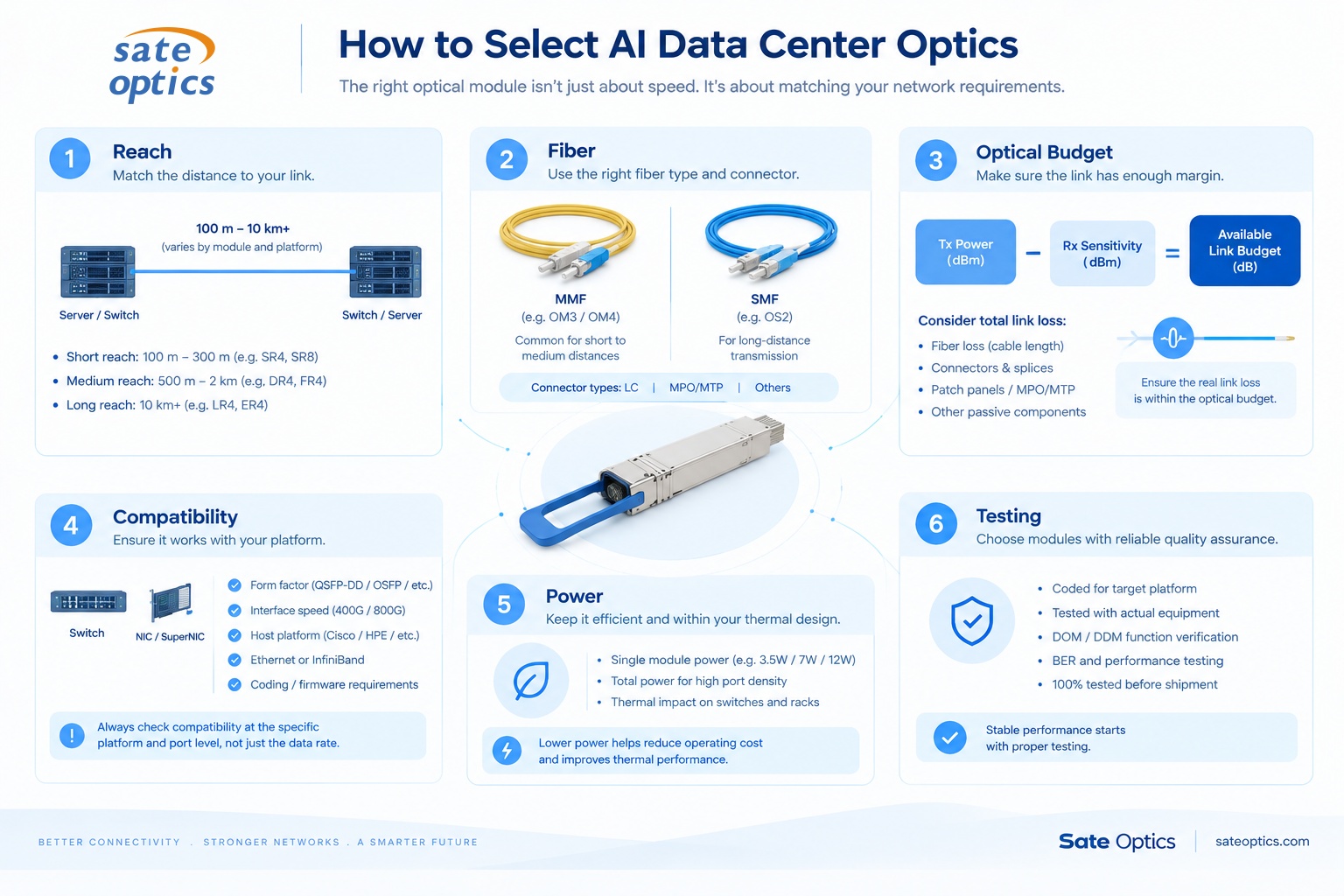
1. Reach
Start with the physical distance.
A short intra-rack connection has very different requirements from a switch-to-switch link across racks or data halls.
Common optical reach categories can include short-reach multimode links and longer-reach single-mode links.
For example, current NVIDIA optical specifications include 400G/800G solutions with reaches such as 500 m for DR-class configurations and 2 km for FR-class configurations, depending on the specific product and platform.
Do not select the optic first and check the distance later.
The required reach should be one of the first filters.
2. Fiber and Connector
The transceiver and the fiber plant must match.
Depending on the application, this may involve:
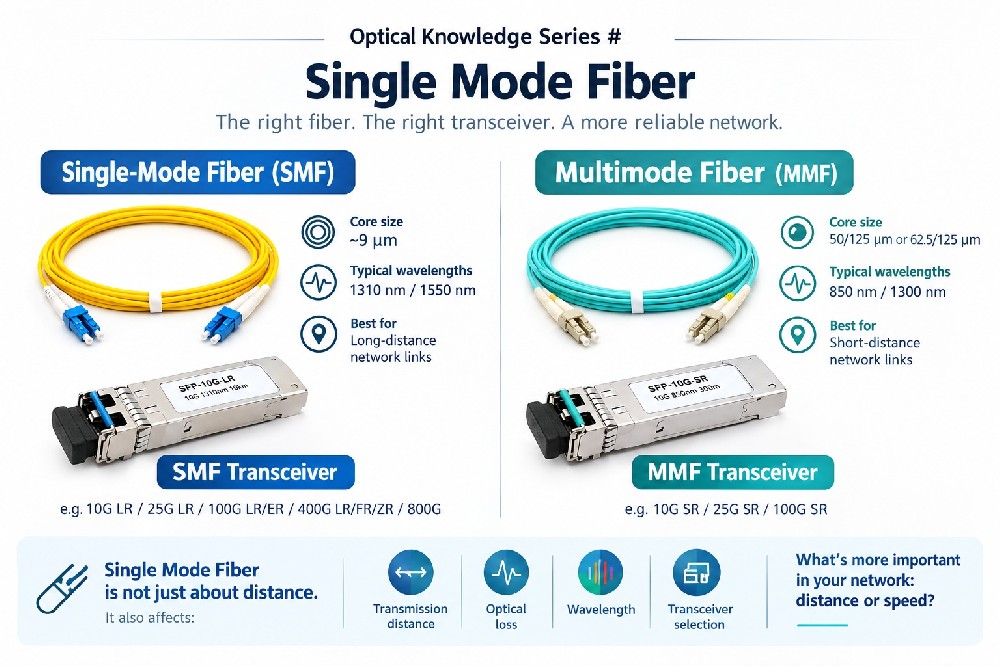
Multimode fiber (MMF)
Single-mode fiber (SMF)
LC connectors
MPO/MTP or other multi-fiber interfaces
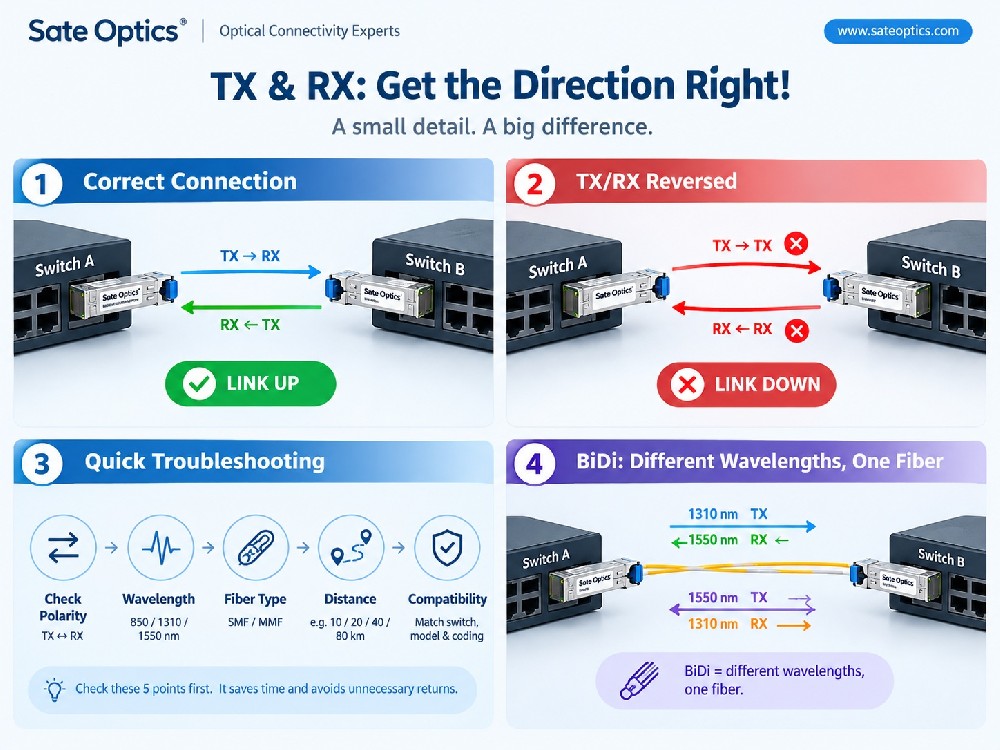
At 400G and above, connector configuration and fiber polarity can become especially important because many high-speed parallel-optics solutions use multiple optical lanes.
A mismatch in fiber type, connector configuration or polarity can prevent a link from operating correctly even when the nominal transceiver speed is correct.
3. Optical Budget
Distance alone does not determine whether an optical link will work.
You also need to consider the total loss in the optical path.
A simplified optical budget is related to:
Transmitter output power − Receiver sensitivity
The available margin then needs to accommodate the losses introduced by:
Fiber
Connectors
Splices
Patch panels
MTP/MPO connections
Other passive components
This is particularly important in high-speed networks because the available margin can be limited.
For a real deployment, the transceiver specification and the actual link loss should always be checked together.
4. Platform Compatibility
A 400G or 800G label does not guarantee interoperability.
The optical module needs to match the actual host platform.
Important questions include:
Which switch?
Which NIC or SuperNIC?
Which connector and form factor?
Ethernet or InfiniBand?
Which coding or firmware requirements apply?
For example, NVIDIA documents different optical interfaces and compatibility combinations for its switches and ConnectX/BlueField platforms. Its validated configurations also emphasize tested combinations of components for AI networking deployments.
For this reason, compatibility should be checked at the specific platform and port level, rather than relying only on the generic data rate.
5. Power, Monitoring and Testing
At high port densities, power consumption becomes a practical consideration.
An optical transceiver may consume only a relatively small amount of power individually, but hundreds or thousands of high-speed ports can make the total impact significant.
Power also becomes part of the thermal design of switches and network equipment.
Monitoring is another useful consideration.
Depending on the module and platform, DOM/DDM can provide information such as:
Transmit optical power
Receive optical power
Temperature
Supply voltage
Laser bias current
This information can help network teams diagnose abnormal links and monitor optical performance.
Testing before deployment is equally important.
A high-speed optic should not only be coded for the target platform; it should also be verified against the intended equipment and application requirements.
AI Networking Is Not Only About Higher Speed
It is tempting to think that the evolution of AI networking is simply:
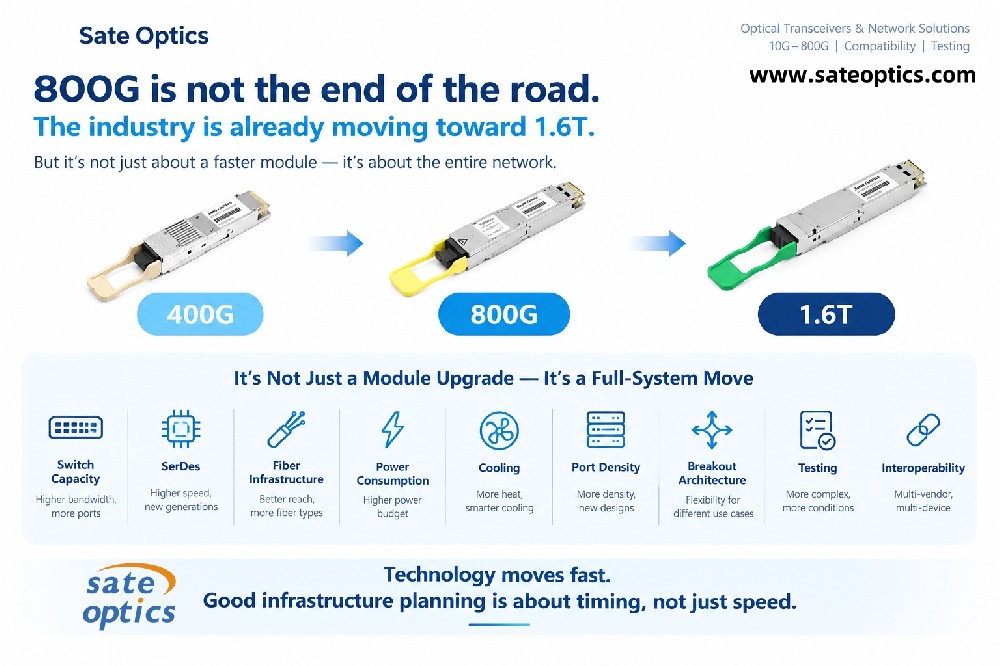
100G → 400G → 800G → 1.6T
But the real engineering challenge is broader.
As network speeds increase, the infrastructure has to deal with:
Higher port density
Higher optical bandwidth
Power and thermal constraints
More complex fiber connectivity
Tight optical budgets
Interoperability requirements
Network resiliency
Large-scale testing and deployment
NVIDIA is already working on technologies beyond traditional pluggable optics, including silicon photonics and co-packaged optics for large-scale AI networks. Its current materials describe 1.6T-class and higher-bandwidth networking architectures aimed at scaling AI infrastructure.
This does not mean that pluggable optical transceivers are disappearing.
Rather, it shows that optical connectivity is becoming an increasingly important design consideration as AI networks scale.
Application Scenarios
AI Data Centers
Large GPU clusters require high-speed connections between compute nodes and network switches.
400G and 800G optical connectivity can be used in high-bandwidth AI network fabrics, depending on the platform, topology and required reach.
High-Performance Computing (HPC)
HPC environments also depend on communication between distributed compute resources.
High-speed Ethernet or InfiniBand networks can use optical connectivity to provide the required bandwidth across racks and data center infrastructure.
Enterprise AI Infrastructure
Not every AI deployment requires an enormous GPU cluster.
Enterprise environments may deploy smaller AI clusters for machine learning, inference, analytics or other workloads.
In these environments, the correct optical solution should be based on actual network requirements rather than simply selecting the highest available speed.
A Practical Checklist for AI Optical Connectivity
Before ordering high-speed optical transceivers, it is useful to confirm:
1. Host equipment
Which switch, NIC or SuperNIC will be used?
2. Interface speed
400G, 800G or another rate?
3. Form factor
QSFP-DD, OSFP, QSFP112 or another platform-specific interface?
4. Reach
What is the actual fiber distance?
5. Fiber
MMF or SMF?
6. Connector
LC, MPO/MTP or another interface?
7. Optical budget
What is the total expected link loss?
8. Compatibility
Is the module coded and validated for the target platform?
9. Power and temperature
Does the module fit the equipment's power and thermal requirements?
10. Testing
Has the module and link been properly tested before deployment?
This checklist can help prevent a common mistake:
choosing an optical module based only on speed.
The Bigger Picture
AI infrastructure is often described as a race for more compute.
But compute is only one part of the system.
Large AI clusters also depend on the network connecting those compute resources.
And inside that network, optical connectivity is one of the components that needs to be engineered carefully.
The right optical solution is therefore not necessarily:
the fastest module.
It is the module that matches the:
speed + reach + fiber + connector + optical budget + platform compatibility + power + testing requirements
of the actual network.
AI infrastructure = Compute + Networking + Optics
As AI clusters continue to scale, understanding the network behind the GPUs will become just as important as understanding the GPUs themselves.
Frequently Asked Questions
What optical transceivers are used in AI data centers?
AI data centers can use a range of optical transceivers depending on the network architecture, switch, NIC, distance and data rate. 400G and 800G solutions are increasingly used in high-performance AI networking, while newer 1.6T-class technologies are emerging.
Is 800G always better than 400G for AI networks?
No.
The appropriate speed depends on the switch, NIC, topology, workload and deployment requirements. Higher bandwidth can be useful, but the complete link must be designed around the required speed, reach, compatibility, power and optical budget.
What is the difference between 400G and 800G optics?
The primary difference is the aggregate data rate, but the physical implementation also differs. Form factor, electrical lane configuration, modulation, optical lanes, connector type, reach and host-platform compatibility can vary between solutions.
Do AI data centers use Ethernet or InfiniBand?
Both can be used.
The choice depends on the AI cluster architecture and deployment requirements. NVIDIA's current AI networking platforms support both Ethernet and InfiniBand solutions across different products and architectures.
Why is optical budget important for 400G and 800G links?
The optical budget determines whether the transmitter and receiver have enough margin to operate reliably over the actual link, taking fiber and connection losses into account.
What should I check before buying 400G or 800G transceivers?
At minimum, confirm the host switch/NIC, interface speed, form factor, reach, fiber type, connector, optical budget, power requirements, compatibility and testing requirements.
Sate Optics: Optical Connectivity for High-Speed Networks
Sate Optics provides compatible optical transceivers and related networking products for data center, enterprise and telecom applications.
Our optical portfolio covers a broad range of speeds and form factors, including 1G, 10G, 25G, 40G, 100G, 200G, 400G and 800G solutions, depending on application and platform requirements.
We can support compatibility requirements for major networking platforms and help customers evaluate the appropriate combination of:
Optical transceiver
Switch / NIC compatibility
Fiber type
Reach
Connector
Optical budget
DOM/DDM
Testing requirements
For high-speed network projects, the goal is not simply to select a faster optic.
The goal is to select the right optic for the actual link.
If you are planning a 400G, 800G or other high-speed network deployment, contact Sate Optics with your switch/NIC model, required distance and fiber configuration. We can help identify suitable optical connectivity options for the application.
Sate Optics | Compatible Optical Transceivers & Networking Solutions
sateoptics.com
Previous:Single-Mode Fiber vs Multimode Fiber: A Simple Guide to Choosing the Right Transceiver