
What Is Return Loss in an SFP? | Sate Optics
2026-10-08 22:37:33
What Is Return Loss in an SFP? A Simple Guide for Network Engineers
Return Loss is an important optical parameter in SFP and other optical transceivers, but it is also one of the easiest specifications to misunderstand.
One simple rule makes it easier:
Higher Return Loss is better.
But why?
And how is Return Loss different from Insertion Loss?
This guide explains Return Loss in SFPs in simple, practical terms.
What Is Return Loss?
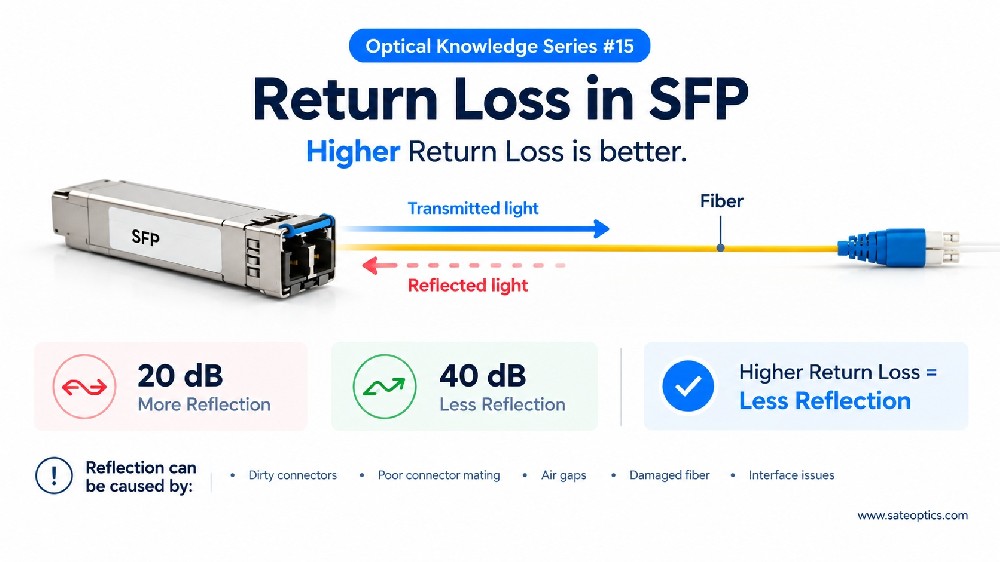
Return Loss (RL) measures the amount of optical power that is reflected back toward the transmitter because of an optical interface or discontinuity.
It is expressed in decibels (dB).
Unlike many loss specifications, a higher Return Loss value indicates less reflected optical power.
For example:
20 dB Return Loss → more reflection
40 dB Return Loss → less reflection
So:
Higher Return Loss = Less Reflection = Better
This is an important distinction when evaluating optical transceivers and fiber links.
Why Does Return Loss Matter in an SFP?
An optical transceiver sends light through a fiber link. Ideally, most of that optical energy travels toward the receiver.
However, imperfections at optical interfaces can cause part of the light to reflect back toward the transmitter.
Excessive reflection can contribute to optical signal degradation and may affect link performance, particularly in higher-speed or more sensitive optical systems.
Return Loss can therefore be one of the parameters worth considering when troubleshooting or evaluating an optical link.
What Can Cause Optical Reflection?
Return Loss can be affected by conditions at optical interfaces, including:
Dirty or contaminated connector end faces
Poorly mated connectors
Air gaps
Damaged or poorly terminated fiber
Connector/interface mismatch
Other discontinuities in the optical path
A connector may look physically connected while its optical interface is not performing as expected.
This is why cleaning and inspecting fiber connectors is an important part of optical troubleshooting.
Return Loss vs. Insertion Loss
Return Loss and Insertion Loss sound similar, but they describe different things.
| Parameter | What it describes | Better value |
|---|---|---|
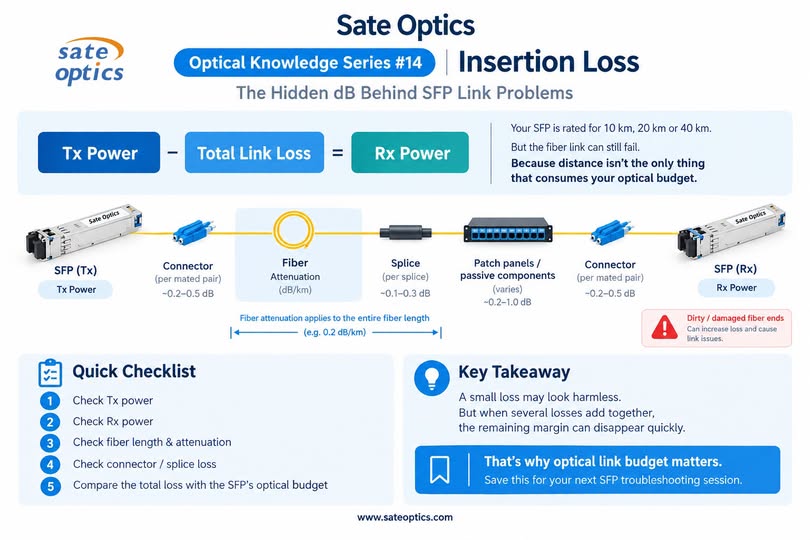
| Insertion Loss | Optical power lost while passing through the link/component | Lower |
| Return Loss | Optical power reflected back toward the source | Higher |
A simple way to remember it:
Insertion Loss → Lower is better
Return Loss → Higher is better
This distinction is especially useful when reading optical transceiver or fiber component specifications.
Does Return Loss Depend Only on the SFP?
No.
Return Loss is not necessarily determined by the SFP alone.
The complete optical path can include:
SFP → Connector → Fiber → Connector → Patch Panel → Fiber → Receiver
Each optical interface can potentially introduce reflection.
Therefore, when troubleshooting an optical link, it is important to consider the entire optical path rather than assuming the transceiver is the only possible source of the problem.
What Should Buyers Check When Choosing an Optical Transceiver?
Return Loss is only one part of optical performance.
When selecting an SFP or other optical transceiver, buyers should also consider:
Data rate
Wavelength
Fiber type
Transmission distance
TX optical power
RX sensitivity
Optical power budget
Insertion Loss
Return Loss
Connector type
Device compatibility
Operating temperature
For compatible optical transceivers, device coding and testing are also important.
A module should be correctly coded for the target networking platform and tested before shipment whenever required by the application.
A Simple Example
Imagine you are troubleshooting an SFP link and the basic specifications appear normal.
You may check:
TX Power → Is the transmitter output normal?
RX Power → Is enough optical power reaching the receiver?
Insertion Loss → Is excessive power being lost along the link?
Return Loss → Is excessive optical power being reflected back toward the transmitter?
Looking at these parameters together provides a more complete picture of optical link performance.
Key Takeaway
Return Loss is a useful optical parameter for understanding reflection in SFP and fiber links.
Remember the simple rule:
Higher Return Loss = Less Reflection
And don't confuse it with Insertion Loss:
Insertion Loss → Lower is better
Return Loss → Higher is better
For network engineers and buyers, understanding both parameters can make optical transceiver selection and troubleshooting much easier.
Sate Optics Compatible Optical Transceivers
Sate Optics supplies compatible optical transceivers for a wide range of networking platforms and applications.
Available solutions include SFP, SFP+, SFP28, QSFP, QSFP28, QSFP56, QSFP-DD and other optical transceivers, depending on the application.
Compatible modules can be coded and tested for the target device before shipment. Sate Optics also supports OEM requirements, custom labeling, repeat orders and different transmission distances.
For help selecting the right optical transceiver for your network, contact Sate Optics with your device model, data rate, fiber type and required distance.
FAQ
Is higher Return Loss better?
Yes. A higher Return Loss value means less optical power is reflected back toward the transmitter.
What is a good Return Loss value for an SFP?
The appropriate Return Loss specification depends on the transceiver, connector, fiber system and applicable standard. Always check the manufacturer's specification rather than using one universal value.
What is the difference between Return Loss and Insertion Loss?
Insertion Loss describes the optical power lost while passing through a component or link. Return Loss describes reflected optical power returning toward the source.
Can a dirty connector affect Return Loss?
Yes. Contamination or poor connector mating can create optical discontinuities and increase reflection.
Does Return Loss affect SFP link stability?
Excessive reflection can contribute to signal degradation and may affect optical link performance. When troubleshooting an unstable link, Return Loss can be one of the parameters worth investigating.
Do Sate Optics compatible SFPs support different network platforms?
Yes. Sate Optics offers compatible optical transceivers for multiple networking platforms. Modules can be coded and tested for the target device according to the application requirements.
Need help selecting an SFP or compatible optical transceiver?
Send us your device model, speed, fiber type and transmission distance, and our team can help identify a suitable solution
Previous:SFP Insertion Loss & Link Loss: Optical Power Guide
Next:No More