
APC vs UPC Fiber Connectors: What’s the Difference and Which One Do You Need?
2026-10-15 20:34:50
APC vs UPC Fiber Connectors: What’s the Difference and Which One Do You Need?
When troubleshooting a fiber link, the optical transceiver is often the first thing people check.
But sometimes the problem is much simpler:
The fiber connector is not the right type.
APC and UPC connectors may look similar at first glance, but they use different polishing geometries and have different reflection characteristics. More importantly, APC and UPC connectors should not be directly mated together.
If you're selecting fiber patch cords, PON equipment, or optical transceivers, this is a small detail worth checking before you connect anything.
What Is UPC?
UPC stands for Ultra Physical Contact.
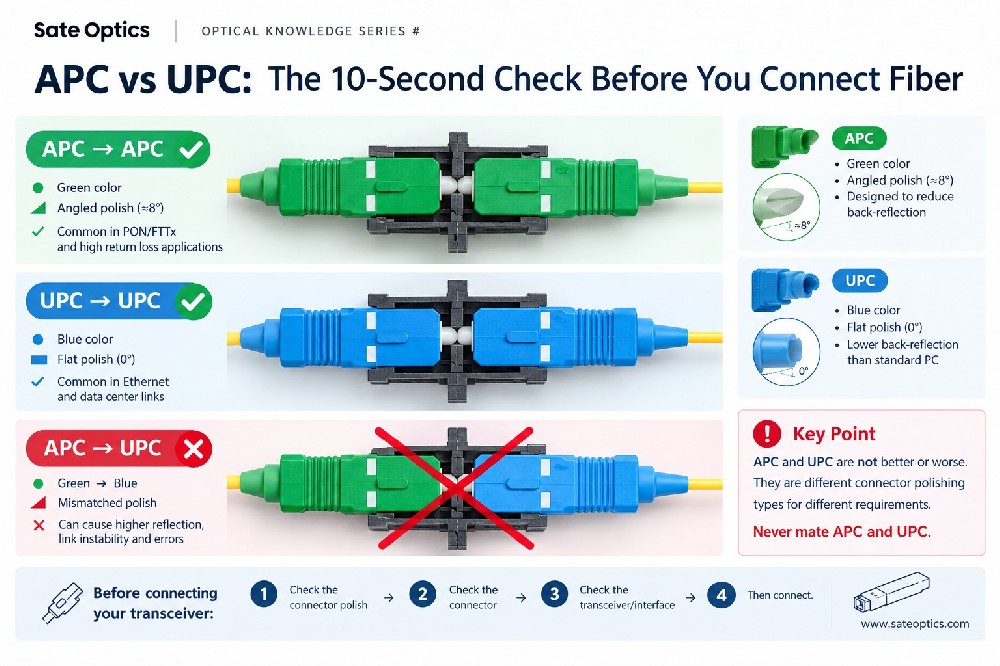
The fiber end face is precisely polished to create a close physical contact between the two fiber cores. UPC connectors are commonly identified by their blue housing or boot.
They are widely used in conventional fiber networking, including many Ethernet and data center applications. CommScope notes that UPC connectivity is commonly used for connecting transceivers, while the exact choice still depends on the system requirements.
For many standard optical links, UPC is the connector type you will encounter most often.
What Is APC?
APC stands for Angled Physical Contact.
Unlike UPC, the end face of an APC connector is polished at an angle, typically around 8 degrees. This angled surface redirects reflected light away from the fiber core, helping to reduce back-reflection.
APC connectors are commonly identified by their green color.
They are frequently used in applications where reflection performance is particularly important, including PON/FTTx and other systems sensitive to reflected optical power.
So the main difference is not simply:
Green is better than blue.
It is about connector geometry and the optical requirements of the system.
APC vs UPC: What Is the Real Difference?
| Feature | UPC | APC |
|---|---|---|
| Full name | Ultra Physical Contact | Angled Physical Contact |
| Typical color | Blue | Green |
| End-face geometry | Spherical/physical contact polish | ~8° angled polish |
| Back-reflection | Low | Lower |
| Common applications | Ethernet, data center, general fiber links | PON/FTTx, telecom and reflection-sensitive applications |
| Can mate directly with the other type? | No | No |
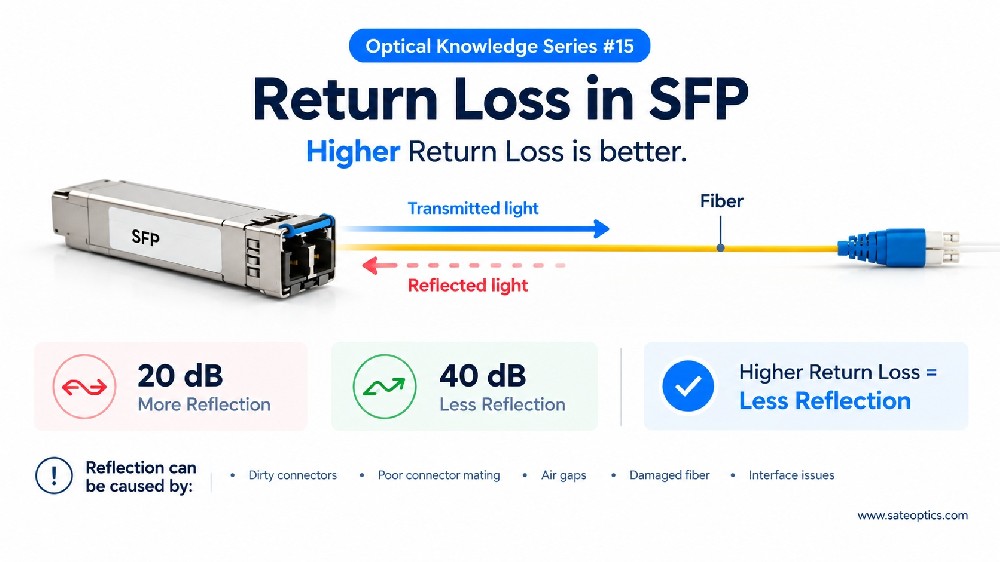
The important specification here is return loss / back-reflection, not simply insertion loss.
For example, Corning's connector specifications show different typical reflectance values for UPC and APC connectors, with APC providing lower reflection.
Can You Connect APC to UPC?
No.
This is one of the easiest mistakes to avoid.
APC → APC ✅
UPC → UPC ✅
APC → UPC ❌
APC and UPC have different end-face geometries. Directly mating them can result in poor optical performance and may damage the connector end faces. Fluke Networks specifically warns that APC and UPC connectors should not be mated.
So if you are replacing a fiber patch cord or optical module, don't choose the connector only by fiber type or transmission distance.
Check the connector polish as well.
Does APC Mean Lower Insertion Loss?
Not necessarily.
This is another common misunderstanding.
APC's main advantage is lower back-reflection, not automatically lower insertion loss.
A well-made UPC connector can also have low insertion loss. The reason APC is selected is usually related to the system's tolerance for reflected optical power.
That's why saying:
“APC is better than UPC.”
is too simplistic.
A better way to think about it is:
Use the connector type that matches the equipment and application.
CommScope similarly describes APC and UPC as choices driven by system requirements and reflection sensitivity rather than a simple better/worse comparison.
How Does This Relate to Optical Transceivers?
This is where APC vs UPC becomes relevant when choosing an optical module.
The APC/UPC designation describes the fiber connector interface and its polish, rather than being a general classification of the transceiver itself.
For example, Sate Optics' PON SFP portfolio includes modules with SC/APC and SC/UPC interfaces, depending on the application and specification. Sate Optics
That means you shouldn't simply ask:
“Do I need an APC transceiver?”
A better question is:
“What connector does my fiber system require, and what connector interface does the transceiver provide?”
This is particularly important for PON equipment, where SC/APC and SC/UPC configurations are both used.
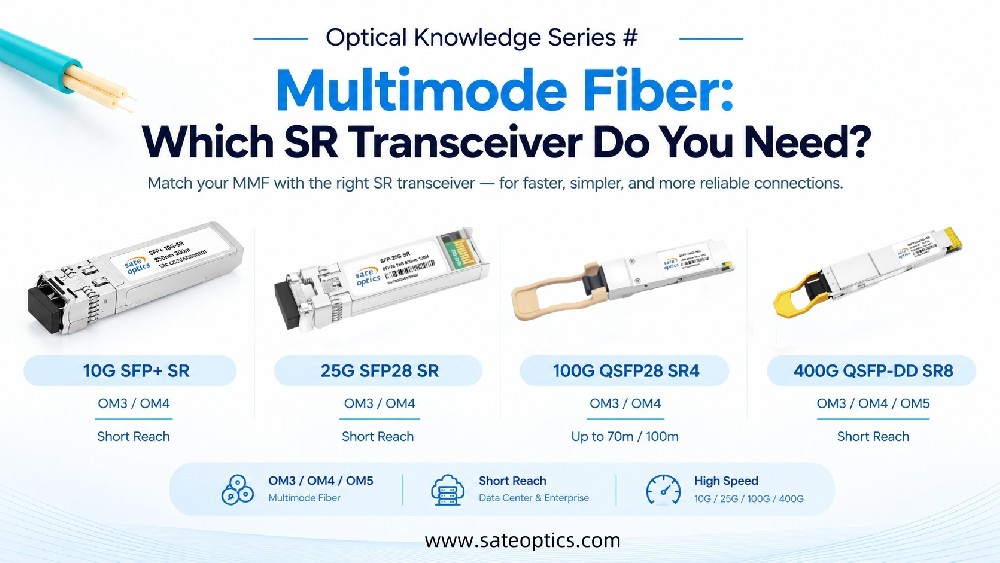
For standard Ethernet transceivers, LC interfaces are much more common. For example, Sate Optics' 100G QSFP28 LR4 and 200G QSFP56 FR4/LR4 products use duplex LC interfaces. Sate Optics
Connector type is therefore one of the specifications to check alongside data rate, wavelength, fiber type, reach, and equipment compatibility.
A Simple Check Before Connecting Fiber
Before plugging in a fiber link, check these four things:
1. Check the connector color
🟢 Green → usually APC
🔵 Blue → usually UPC
Color is a useful visual clue, but don't rely on color alone. Check the actual product specification when the application is critical.
2. Check the connector type
SC, LC, MPO/MTP and other connector formats are not interchangeable.
3. Check the polish
APC → APC
UPC → UPC
Don't directly mate APC with UPC.
4. Check the optical transceiver
Make sure the module's interface, wavelength, fiber type, reach and equipment compatibility match the link you're building.
Common APC vs UPC Mistakes
Mistake 1: Choosing by color only
Green usually indicates APC and blue usually indicates UPC, but color should be treated as a quick visual check rather than the complete specification.
Mistake 2: Assuming APC is always better
APC is useful when lower back-reflection is required. It isn't automatically the right choice for every optical link.
Mistake 3: Mixing APC and UPC
This is the big one.
APC and UPC should not be directly mated.
Mistake 4: Checking the transceiver but not the fiber
A transceiver can have the correct data rate and reach and still be the wrong choice for the physical connection you have.
APC vs UPC: The Quick Answer
If you only remember four things, remember these:
🔵 UPC = blue, standard physical-contact polish
🟢 APC = green, angled polish, lower back-reflection
✅ APC → APC
✅ UPC → UPC
❌ APC → UPC
And when selecting an optical transceiver, don't look at the module alone.
Check the entire link: transceiver + connector + fiber + equipment.
Choosing the Right Optical Transceiver
Connector compatibility is only one part of selecting an optical transceiver.
Depending on the application, you may also need to check:
Data rate
Transmission distance
Wavelength
Single-mode or multimode fiber
Connector interface
TX/RX optical power
Temperature range
Host equipment compatibility
Sate Optics provides compatible SFP, SFP28, SFP+, QSFP+, QSFP28, QSFP56, QSFP-DD and OSFP optical transceivers for different network speeds and applications. The current portfolio covers applications from 1G through 1.6T. Sate Optics
Need help checking a transceiver specification?
Send us the device model, transceiver model, fiber type, connector type and required distance. Our team can help check the configuration before you place an order.
Explore Sate Optics Optical Transceivers
FAQ
Is APC better than UPC?
Not universally. APC provides lower back-reflection and is preferred in applications where reflected optical power is more critical. UPC is widely used for standard fiber connectivity. The appropriate choice depends on the system requirements.
Can I connect an APC connector to a UPC connector?
No. APC and UPC connectors should not be directly mated because their end-face geometries are different and the connection can result in poor performance or damage.
What color is an APC connector?
APC connectors are commonly green, while UPC connectors are commonly blue. However, always verify the actual product specification rather than relying only on color.
Are APC and UPC used with optical transceivers?
Yes. The appropriate connector interface depends on the transceiver and network application. PON equipment, for example, can use SC/APC or SC/UPC configurations. Sate Optics
Does APC reduce insertion loss?
The main purpose of APC is to reduce back-reflection/return loss. It should not be described simply as a connector with lower insertion loss. Connector insertion loss depends on the specific connector design and manufacturing quality.
Previous:LPO vs CPO vs Pluggable Optics: Key Differences
Next:No More