
How to Choose the Right Network Speed: 1G to 800G
2026-08-28 14:45:54
How to Choose the Right Network Speed: Why You May Not Need 400G or 800G
Not every network needs the fastest optical transceiver. Learn how to choose the right network speed based on traffic demand, distance, network architecture, compatibility, and future expansion.
Network speeds are advancing quickly.
10G, 25G, 100G, 200G, 400G and 800G optical transceivers are now available for everything from enterprise networks to high-density AI data centers. With these options becoming more accessible, it is easy to assume that a higher-speed connection is always the better choice.
But that is not necessarily true.
A 400G or 800G optical transceiver does not automatically make a network faster. The switch, NIC, fiber infrastructure, transceiver, and overall network architecture must all support the target speed.
In many deployments, choosing the highest available bandwidth can simply increase equipment cost and complexity without delivering a meaningful performance benefit.
The better question is:
What network speed does this specific link actually need?
1. Why Faster Does Not Always Mean Better
Network design is not simply a race toward higher bandwidth.
A practical network upgrade should consider several factors:
Current traffic volume
Number of connected devices
Link distance
Port capacity
Server and NIC performance
Switch compatibility
Fiber infrastructure
Network architecture
Future expansion requirements
Cost per port
For example, a small office with dozens of computers and cloud applications may have no practical reason to deploy 400G connections.
At the other end of the spectrum, an AI data center moving large volumes of traffic between GPUs and switches may quickly outgrow 100G connectivity.
The right speed depends on the application.
2. Choosing Network Speed by Application
Different environments have very different bandwidth requirements.
Small Office Networks: 1G or 10G
A typical small office may include:
PCs and laptops
VoIP phones
Cloud applications
Internet access
Printers
Basic file sharing
Small servers
For many of these environments, 1G Ethernet remains sufficient.
Where higher performance is required, 10G connectivity can provide a practical upgrade for servers, NAS systems, uplinks, and other high-bandwidth devices.
Common options include:
1G SFP
10G SFP+
10G DAC
10G AOC
There is usually little reason to deploy 400G or 800G connectivity simply because it is available.
A useful analogy is using a highway to deliver one package. More capacity does not necessarily make the individual delivery more efficient.
Application Scenario
Small office → 1G access + 10G server/uplink
This approach can provide sufficient performance while keeping deployment and equipment costs under control.
3. Enterprise Networks: 10G, 25G and 100G
Enterprise environments introduce more demanding traffic patterns.
Modern enterprise networks may support:
Virtualization
Database applications
High-performance servers
Storage traffic
Video applications
Cloud services
Multiple departments
Server-to-server communication
This is where 10G and 25G optical connectivity can become particularly useful.
10G SFP+ for Server and Network Connections
10G SFP+ remains a common choice for server connectivity and network uplinks.
For short-distance connections inside a rack, a 10G SFP+ DAC can often provide a simple and cost-effective solution.
For longer connections, 10G optical transceivers with single-mode or multimode fiber can be used depending on the required distance.
25G SFP28 for Higher-Performance Servers
25G SFP28 provides more bandwidth per port than 10G while maintaining a compact SFP form factor.
It is commonly considered for:
High-performance servers
Data center leaf switches
Server-to-switch connections
Virtualized environments
For organizations planning future expansion, 25G can also provide additional bandwidth without immediately moving to much higher-speed interfaces.
100G QSFP28 for High-Capacity Uplinks
When traffic becomes concentrated between switches or aggregation layers, 100G QSFP28 can be a practical solution.
Common 100G options include:
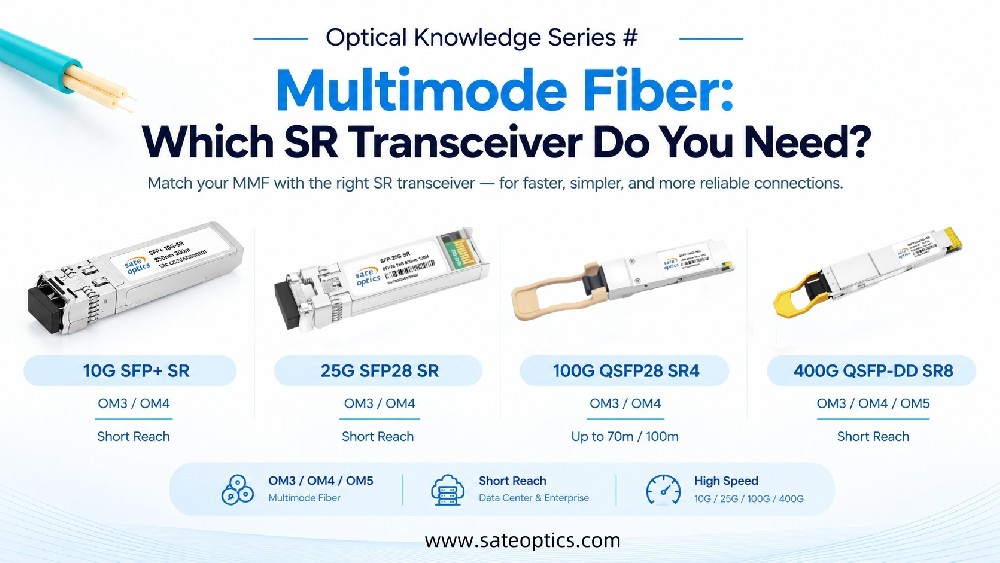
100G QSFP28 SR4
100G QSFP28 LR4
100G QSFP28 ER4
100G QSFP28 ZR4
The specific transceiver should be selected according to the required distance, fiber type, connector, and switch compatibility.
4. ISP and Telecom Networks: Why 100G and 400G Matter
ISP and telecom networks operate on a completely different traffic scale.
Instead of serving a limited number of office users, network operators may aggregate traffic from:
Thousands or millions of subscribers
FTTH networks
Enterprise customers
Mobile networks
Metro networks
Data centers
Regional backbone links
At this level, bandwidth aggregation becomes critical.
A single high-capacity optical link can carry traffic generated by many lower-speed connections.
This is where 100G, 400G and higher-speed optical transceivers become increasingly important.
For example, a 100G QSFP28 interface may be suitable for one part of an aggregation network, while 400G QSFP-DD or OSFP connectivity may be more appropriate for a high-capacity data center or backbone connection.
The key question is not:
“What is the fastest optical module available?”
It is:
“How much traffic needs to move through this link?”
5. Data Centers: 100G, 200G and 400G
Modern data centers have become increasingly bandwidth-intensive.
Traffic is no longer limited to traditional client-to-server communication.
Large volumes of traffic may move between:
Server ↔ Switch
Switch ↔ Switch
Server ↔ Storage
Data Center ↔ Data Center
As network architectures evolve toward leaf-spine designs, east-west traffic can become a major consideration.
This makes 100G and 400G optical connectivity increasingly relevant.
100G QSFP28
100G QSFP28 remains widely used for:
Data center uplinks
Leaf-to-spine connections
High-capacity server aggregation
Enterprise data centers
400G QSFP-DD
400G QSFP-DD provides significantly higher bandwidth density and is designed for modern high-performance networking environments.
Typical applications include:
Data center spine networks
High-density switching
Cloud infrastructure
Large-scale computing
AI infrastructure
400G Optical Transceiver Examples
Depending on the application and distance, different 400G optical solutions may be used.
Examples include:
400G QSFP-DD FR4
400G QSFP-DD DR4
400G QSFP-DD SR8
400G OSFP solutions
The correct selection depends on transmission distance, fiber type, connector configuration, switch compatibility, and network architecture.
6. AI and GPU Clusters: Where 400G and 800G Become More Important
AI infrastructure is one of the major drivers behind the rapid development of 400G and 800G networking.
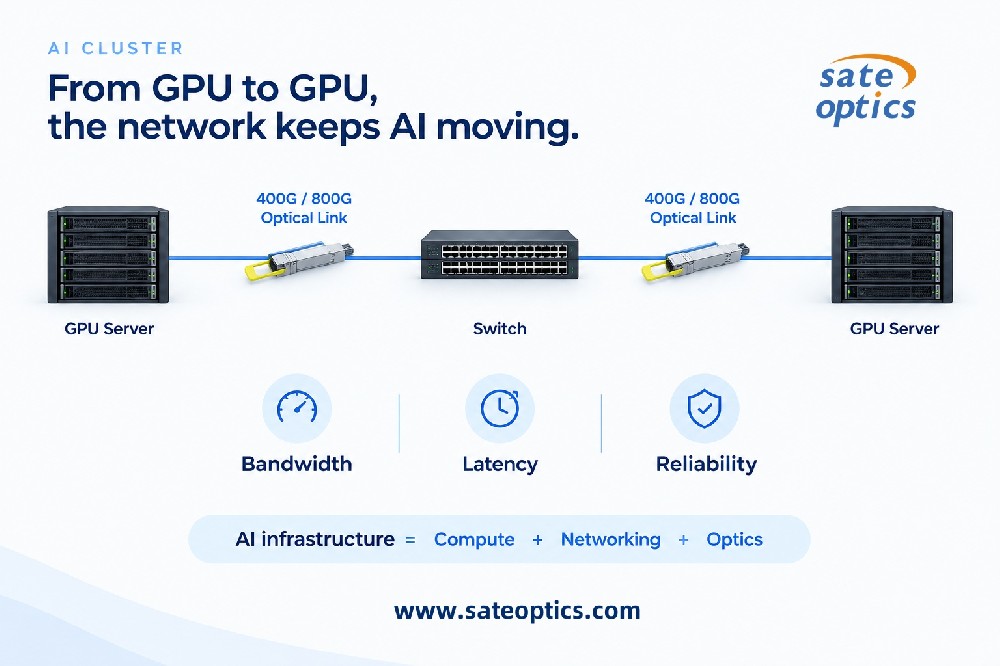
Large GPU clusters generate enormous amounts of east-west traffic.
Data may continuously move between:
GPU ↔ GPU
GPU ↔ Switch
Switch ↔ Switch
Server ↔ Storage
In these environments, network bandwidth can directly influence how efficiently computing resources communicate.
This is why 400G and 800G optical transceivers are increasingly important for AI and hyperscale data center deployments.
For example:
400G QSFP-DD can support high-bandwidth data center connections.
400G OSFP can be used in high-density switching environments.
800G OSFP solutions are designed for next-generation AI and hyperscale networks.
However, even in an AI data center, not every connection automatically needs 800G.
Network architecture determines where the highest bandwidth is actually required.
7. A Simple Network Speed Guide
The following provides a general way to understand where different speeds may fit:
| Network Speed | Common Applications | Typical Form Factor |
|---|---|---|
| 1G | Office access, basic connectivity | SFP |
| 10G | Servers, office uplinks, enterprise networks | SFP+ |
| 25G | High-performance servers, data centers | SFP28 |
| 40G | Legacy and specialized data center deployments | QSFP+ |
| 100G | Data center uplinks, enterprise aggregation | QSFP28 |
| 200G | High-capacity data center networks | QSFP56 / QSFP-DD |
| 400G | Modern data centers, cloud and AI infrastructure | QSFP-DD / OSFP |
| 800G | AI clusters, hyperscale and next-generation networks | OSFP |
These are general guidelines, not strict rules.
Actual requirements vary from one deployment to another.
8. DAC, AOC or Optical Transceiver?
Network speed is only one part of the connectivity decision.
The physical connection also matters.
DAC: Best for Short Connections
Direct Attach Copper (DAC) cables are commonly used for short-distance connections.
Typical applications include:
Server-to-switch
Switch-to-switch
Same-rack connections
Short top-of-rack deployments
DAC can be particularly attractive when distance is very short and cost efficiency is important.
AOC: Convenient for Longer Short-Range Connections
Active Optical Cable (AOC) combines optical transmission with permanently attached transceiver ends.
AOC can be useful when:
The connection is longer than practical copper DAC
A pre-terminated solution is preferred
High-speed connectivity is required
Simplified cabling is desirable
Optical Transceivers + Fiber: Flexible for Longer Links
For longer-distance connections, separate optical transceivers and fiber optic cables provide more flexibility.
This approach allows engineers to select the appropriate:
Transceiver
Wavelength
Fiber type
Connector
Transmission distance
For example, a 100G QSFP28 LR4 can be paired with suitable single-mode fiber for longer-distance data center or network connections.
9. Why a Faster Optical Transceiver Does Not Automatically Make a Network Faster
This is one of the most important points for network buyers.
A high-speed optical transceiver works as part of a complete network system.
The following components must work together:
Switch + NIC + Fiber + Optical Transceiver + Network Architecture
For example, installing a 400G optical transceiver does not turn a 100G switch port into a 400G port.
The switch must support the required interface and speed.
The connected NIC or other network device must also support the target bandwidth.
The fiber infrastructure must meet the transmission requirements.
And the network architecture must be designed to take advantage of the additional capacity.
This is why checking compatibility before purchasing optical modules is essential.
10. What Should You Check Before Buying an Optical Transceiver?
Before selecting a module, consider these questions.
1. What speed does the port support?
Check whether the switch or network device supports:
1G
10G
25G
40G
100G
200G
400G
800G
2. What is the required transmission distance?
Distance has a major impact on transceiver selection.
A short rack connection may only require DAC or AOC.
A longer link may require an optical transceiver designed for 10 km, 20 km, 40 km, 80 km or beyond.
3. What fiber will be used?
Determine whether the deployment uses:
Multimode fiber
Single-mode fiber
LC connectivity
MPO/MTP connectivity
The transceiver must match the fiber infrastructure.
4. Is the transceiver compatible with the switch?
Compatibility should be confirmed before procurement.
For OEM-compatible optical modules, the exact switch model, port type, firmware requirements, coding and supported optics should be checked.
5. Do you need future scalability?
Choosing the lowest-cost option is not always the best long-term strategy.
If traffic is expected to increase significantly, moving from 10G to 25G or from 100G to 400G may provide a more practical upgrade path.
The goal is to balance:
Current requirements + Future growth + Total deployment cost
11. Common Optical Transceiver Models and Keywords
When researching network upgrades, buyers may encounter many different module specifications.
Some commonly searched product types include:
10G
SFP-10G-SR
SFP-10G-LR
SFP-10G-ER
SFP+ SR
SFP+ LR
25G
SFP-25G-SR
SFP-25G-LR
SFP28 SR
SFP28 LR
QSFP-40G-SR4
QSFP-40G-LR4
QSFP-40G-ER4
QSFP-40G-CSR4
100G
QSFP-100G-SR4-S
QSFP-100G-LR4-S
QSFP-100G-ER4
QSFP-100G-ZR4
400G
400G QSFP-DD FR4
400G QSFP-DD DR4
400G QSFP-DD SR8
400G OSFP
800G
800G OSFP SR8
800G OSFP optical transceiver
800G high-density optical solutions
The exact model required depends on equipment compatibility, transmission distance, fiber type and application.
12. Application-Based Recommendations
Instead of selecting a speed first, start with the application.
Small Office
Typical requirement: Basic connectivity and cloud applications
Possible solution:
1G SFP or 10G SFP+ for selected uplinks and servers.
Enterprise Server Network
Typical requirement: Virtualization, storage and high-performance applications
Possible solution:
10G SFP+ or 25G SFP28.
Data Center Aggregation
Typical requirement: High-capacity leaf-spine or switch-to-switch connectivity
Possible solution:
100G QSFP28 or 400G QSFP-DD.
ISP / Telecom
Typical requirement: Aggregated subscriber and backbone traffic
Possible solution:
100G, 400G and higher-speed optical solutions depending on network architecture.
AI / GPU Cluster
Typical requirement: Extremely high east-west bandwidth
Possible solution:
400G QSFP-DD, 400G OSFP or 800G OSFP depending on the architecture and switch platform.
13. The Best Network Speed Is the Right Network Speed
There is no universal answer to the question:
“What is the best network speed?”
For one organization, 10G may provide more than enough capacity.
For another, 25G may be the most practical server connection.
A large data center may need 100G or 400G uplinks.
An AI cluster may require 800G connectivity for specific high-bandwidth connections.
The important thing is to match the optical solution to the actual network requirement.
Instead of asking:
❌ “What is the fastest optical transceiver available?”
Ask:
✅ “What speed, distance and connectivity type does this link actually require?”
That small change in thinking can help reduce unnecessary costs while leaving enough room for future growth.
FAQ
Do I need 400G optical transceivers for a data center?
Not necessarily. Many enterprise and data center environments can still use 10G, 25G or 100G depending on traffic patterns and network architecture. 400G becomes more relevant when high-density aggregation, cloud infrastructure or AI workloads require substantially higher bandwidth.
Is 800G only for AI networks?
No. 800G is also relevant to hyperscale data centers and other next-generation high-bandwidth networks. However, AI and GPU clusters are important applications because of their extremely high east-west traffic requirements.
Is 25G better than 10G?
Not automatically. 25G provides more bandwidth per port, which can be valuable for high-performance servers and modern data centers. If a device only requires 10G, however, upgrading to 25G may not provide enough additional value to justify the cost.
What is the difference between DAC and optical transceivers?
DAC integrates the electrical connection and connector ends into one copper cable and is generally intended for short distances. Optical transceivers are installed separately and used with fiber optic cables, providing greater flexibility for longer-distance connections and different network architectures.
Can I use a 400G transceiver on a 100G switch?
Not simply because the module supports 400G. The switch port, firmware, interface, breakout configuration and overall equipment compatibility must support the intended configuration. Always verify the switch manufacturer's specifications and the exact transceiver compatibility before deployment.
Should I choose QSFP-DD or OSFP for 400G?
The choice depends primarily on the switch platform and system architecture. QSFP-DD and OSFP have different mechanical and thermal characteristics, so the transceiver must match the equipment's supported form factor.
How do I choose the correct optical transceiver?
Start with five basic parameters:
Network speed
Transmission distance
Fiber type
Connector type
Equipment compatibility
Then consider future bandwidth requirements and total deployment cost.
Need Help Choosing the Right Optical Connectivity?
Choosing the correct optical transceiver is not simply about selecting the highest available speed.
Whether you are deploying 10G SFP+, 25G SFP28, 100G QSFP28, 400G QSFP-DD, 400G OSFP or 800G OSFP, the right solution depends on your equipment, distance, fiber infrastructure and traffic requirements.
Sate Optics provides compatible optical connectivity solutions for enterprise networks, data centers, ISP/telecom networks and high-performance computing environments.
Need help selecting the right module?
Send us your:
Switch / device model
Target network speed
Link distance
Fiber type
Application scenario
Our team can help you identify a practical optical connectivity solution for your deployment.
Previous:400G to 4×100G Breakout Cables Explained: DAC vs AOC
Next:Optical Transceivers Are Becoming a Supply Chain Decision | Sate Optics