
Optical Transceivers Are Becoming a Supply Chain Decision | Sate Optics
2026-08-31 21:37:26
Optical Transceivers Are Becoming a Supply-Chain Decision: What Network Buyers Should Consider
For many years, choosing an optical transceiver was mainly a technical and commercial decision.
Network teams looked at compatibility, transmission distance, wavelength, connector type, optical budget, price, and lead time.
Today, there is another question that is becoming increasingly important:
What happens if your usual supply source suddenly changes?
Recent reports that the U.S. Federal Communications Commission (FCC) is working on a potential restriction affecting new Chinese-made optical transceivers for data center applications have brought optical supply-chain resilience into sharper focus. Reuters reported on August 4 that the administration was drafting such a measure, while also noting that the proposal could still be changed, delayed, or shelved. As of August 31, 2026, this should therefore be viewed as a reported regulatory development rather than a final, effective blanket ban.
For network operators and procurement teams, however, the broader lesson goes beyond one country or one regulation.
Optical transceiver sourcing is becoming a supply-chain decision as well as a technical decision.
Why Optical Transceiver Supply Chains Matter More
Optical transceivers may be small components, but they sit at critical points in modern network infrastructure.
A data center may use thousands or even hundreds of thousands of optical modules across server-to-switch, switch-to-switch, leaf-and-spine, storage, and inter-data-center connections.
Depending on the network architecture, these may include:
1G SFP transceivers
10G SFP+ transceivers
25G SFP28 transceivers
40G QSFP+ transceivers
100G QSFP28 transceivers
200G optical transceivers
400G QSFP-DD transceivers
800G QSFP-DD and OSFP transceivers
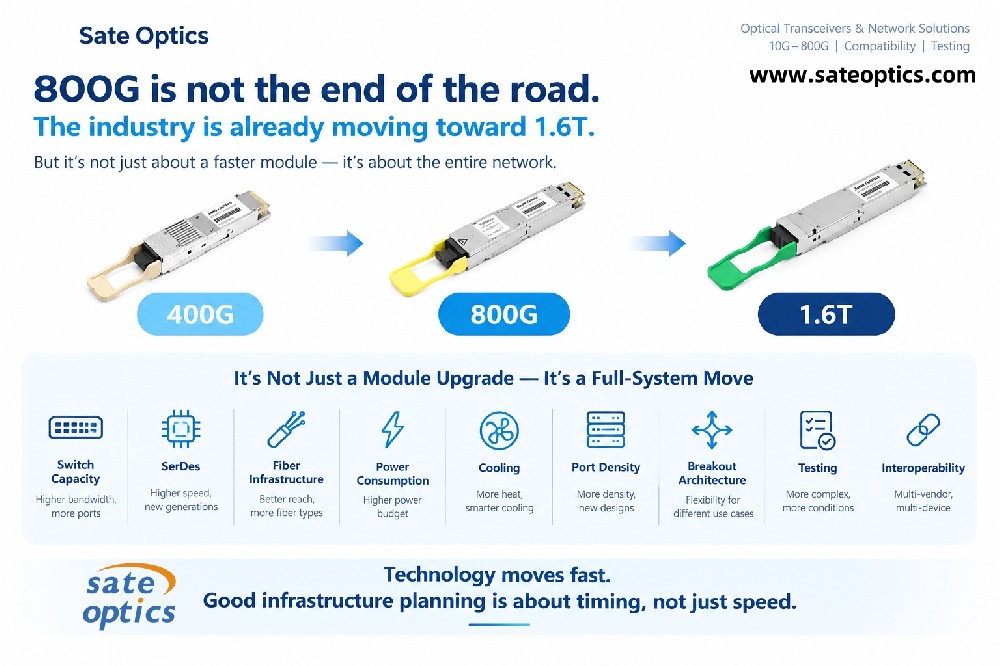
As network speeds increase and AI data center deployments accelerate, the importance of reliable optical supply becomes even greater. High-speed 400G and 800G transceivers are increasingly important for data center connectivity, while 1.6T technology is also moving toward commercial deployment.
This means a sourcing problem is not necessarily just a purchasing problem.
It can become a deployment problem.
The Real Question Is Not “Which Country?”
When supply-chain discussions become geopolitical, it is easy to reduce the issue to a simple question:
“Which country should we buy from?”
That is usually too simple.
A more useful question is:
How resilient is your optical transceiver supply chain?
Country of origin may be an important requirement for certain projects, customers, or markets.
But it is only one part of the overall supply-chain picture.
A supplier outside China can still depend on concentrated sources for lasers, components, wafers, electronics, or other critical materials.
Likewise, a supplier located in China may have multiple production sites, established quality-control processes, inventory, alternative component sources, and a strong ability to support large-volume orders.
The real objective should therefore be:
visibility + qualification + alternatives + continuity.
7 Questions Buyers Should Ask Before Qualifying an Optical Transceiver Supplier
1. Where is the optical transceiver manufactured?
Country of origin can matter for regulatory compliance, customer requirements, government projects, and internal sourcing policies.
Before approving a supplier, buyers should understand where the module is manufactured and whether the supplier can provide the documentation required for the project.
This is particularly relevant for data center deployments serving regulated industries or customers with specific procurement requirements.
2. Do you have a qualified second source?
This may be one of the most important questions.
Imagine that a network currently depends on one supplier for:
100G QSFP28 LR4
100G QSFP28 ER4
400G QSFP-DD FR4
400G QSFP-DD LR4
What happens if the supplier suddenly has a long lead time?
Waiting until the shortage occurs is usually the worst time to begin qualification.
A better strategy is to qualify an alternative supplier before it becomes urgent.
A qualified second source does not necessarily mean replacing the primary supplier.
It means having a realistic Plan B.
3. Has the exact optic been validated for your equipment?
“Compatible with Cisco” or “compatible with Juniper” is not, by itself, enough information.
Buyers should consider the actual:
Equipment platform
Port type
Data rate
Optical standard
Wavelength
Transmission distance
Fiber type
Connector
DOM/DDM requirements
Coding requirements
Firmware or platform-specific behavior
For example, a 100G QSFP28 LR4 intended for a Cisco platform is not automatically interchangeable with every 100G optic simply because all of them use the QSFP28 form factor.
The exact application and equipment compatibility should be validated.
This is particularly important when deploying compatible or third-party optical transceivers.
4. Can the supplier support both normal and peak demand?
A supplier may be able to deliver 20 modules quickly.
That does not automatically mean the same supplier can support 5,000 or 20,000 modules for a major deployment.
Procurement teams should ask:
What is the normal production capacity?
What is the typical lead time?
Which products are normally stocked?
How quickly can production scale?
Are key components readily available?
Can the supplier support repeat orders with consistent specifications?
This becomes increasingly important for high-volume 100G, 400G, and 800G deployments.
5. What does the product lifecycle look like?
A supply problem is not always caused by a factory shutdown.
Sometimes the problem is much simpler:
The product reaches EOL.
This matters when networks are expected to operate for five, seven, or even ten years.
Before approving an optical transceiver, buyers should consider:
Is the product still actively manufactured?
Is it a current-generation specification?
Is there a replacement model?
Can the same specification be reordered later?
Can the supplier maintain consistent coding and performance?
For long-term network projects, product lifecycle management can be just as important as the initial purchase price.
6. Can the supplier provide testing and qualification support?
Optical transceivers should not be evaluated purely by the datasheet.
For important deployments, buyers may want to verify:
Transmit optical power
Receive sensitivity
Extinction ratio
Wavelength
DOM/DDM readings
Temperature performance
BER performance
Compatibility with the target switch or router
Link stability under actual network conditions
For higher-speed products such as 400G and 800G, qualification becomes even more important because the network architecture, lane configuration, optics type, and switch platform all need to work together correctly.
7. How quickly can you activate an alternative supply?
This is where supply-chain resilience becomes practical.
It is not enough to have a supplier's business card.
You need to know whether that supplier can actually become a usable source when required.
A practical qualification process can include:
Step 1 — Technical review
Confirm the exact optical specification and target equipment.
Step 2 — Sample testing
Test representative modules on the actual network platform.
Step 3 — Compatibility validation
Verify coding, DOM/DDM, link stability, and performance.
Step 4 — Commercial qualification
Review MOQ, lead time, warranty, documentation, and production capacity.
Step 5 — Approved supplier status
Keep the alternative supplier qualified even if it is not used for every purchase.
This approach turns “having another supplier” into a real contingency plan.
Optical Transceiver Supply Chain Risk Is Not Limited to One Product
Supply-chain planning should also take the network's optical roadmap into account.
A network may contain several generations of optical modules at the same time.
Enterprise and access networks
Common requirements may include:
1G SFP
10G SFP+
25G SFP28
RJ45 and fiber uplinks
Data center networks
Common requirements may include:
25G SFP28
100G QSFP28
200G QSFP56
400G QSFP-DD
800G QSFP-DD
800G OSFP
Telecom and long-distance fiber networks
Typical applications may include:
10G DWDM
10G ER / ZR
100G LR4
100G ER4
100G ZR
CWDM / DWDM optics
Long-reach single-mode fiber links
The correct sourcing strategy may therefore be different for each application.
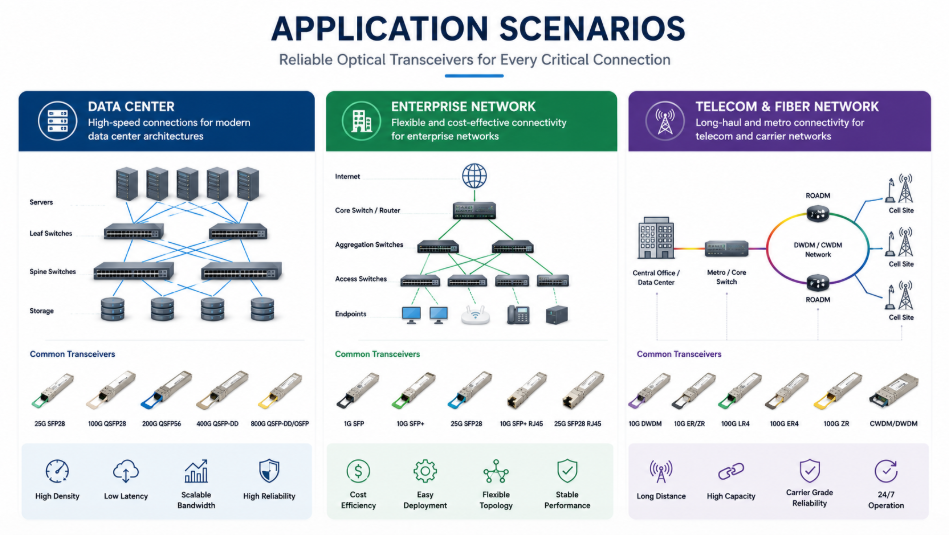
Application Scenarios Where Supply-Chain Planning Matters
Data Center Deployment
Data centers depend heavily on optical connectivity between servers, switches, storage systems, and network layers.
A shortage of the required 100G, 400G, or 800G transceiver can delay equipment commissioning even when the switches and servers are already available.
For large deployments, qualifying alternative optics in advance can reduce this risk.
Enterprise Network Upgrades
Enterprise networks often contain multiple generations of Cisco, Juniper, HPE, Dell, or other network equipment.
A compatible optical transceiver supplier can help maintain connectivity when original-equipment optics are expensive, unavailable, or approaching EOL.
The key is not simply finding a lower-cost optic.
The key is ensuring compatibility and repeatability.
Telecom and Fiber Network Projects
Telecom operators and fiber infrastructure providers may require long-reach optics such as 10G ER/ZR, 100G LR4/ER4/ZR, CWDM, or DWDM modules.
For these projects, optical performance, link budget, distance, wavelength, and long-term availability can be more important than unit price alone.
Network Maintenance and Replacement
Supply-chain resilience is also important after a network has already been deployed.
Maintenance teams may suddenly need replacement optics because of:
Module failure
Link instability
Network expansion
Equipment replacement
EOL products
Unexpected demand
Keeping a qualified alternative source can make replacement much faster.
What Should Buyers Look for in a Compatible Optical Transceiver Supplier?
A good supplier should not only provide a part number.
For professional network deployments, buyers should look for a supplier that can support the complete qualification process.
At Sate Optics, our focus is on compatible optical transceivers for enterprise, telecom, and data center networks, covering common form factors from 1G SFP and 10G SFP+ to 25G SFP28, 100G QSFP28, 400G QSFP-DD, and 800G QSFP-DD/OSFP.
Compatibility options are available for major networking platforms, including Cisco, Juniper, Arista, Huawei, HPE, Dell, and Nokia, depending on the specific model and application.
Our approach is simple:
Don't just ask whether an optic fits the port.
Check whether it fits the network requirement.
That means looking at compatibility, optical performance, coding, testing, availability, lead time, and long-term supply.
Supply-Chain Resilience Starts Before You Need It
The current discussion around Chinese optical transceivers is a useful reminder that network procurement is changing.
Regulations can change.
Tariffs can change.
Lead times can change.
Component availability can change.
Product generations can change.
But the basic procurement principle remains:
A resilient network needs a resilient supply chain.
For many buyers, that does not mean abandoning an existing supplier.
It may simply mean qualifying a second source before there is a problem.
Because the best time to build a Plan B is before you need one.
Need a Second Source for Optical Transceivers?
If you are reviewing your optical supply chain, replacing an EOL optic, qualifying a compatible alternative, or preparing for a new data center deployment, Sate Optics can help evaluate the required specification and compatibility.
We can support a wide range of optical transceiver requirements, including:
SFP | SFP+ | SFP28 | QSFP+ | QSFP28 | QSFP56 | QSFP-DD | OSFP
with solutions covering common 1G, 10G, 25G, 40G, 100G, 200G, 400G, and 800G network applications.
If you already have a part number, equipment model, BOM, or project requirement, send it to us.
We can help you identify a compatible optical solution and determine what should be validated before deployment.
[Contact Sate Optics for Optical Transceiver Qualification →]
Frequently Asked Questions
Are optical transceivers becoming a supply-chain risk?
Yes, optical transceivers can become a supply-chain risk when a network depends heavily on a single supplier, geographic source, component source, or product generation. Recent U.S. regulatory discussions have made geographic sourcing considerations more visible, but supply-chain risk is broader than country of origin alone.
Are Chinese-made optical transceivers currently banned in the United States?
As of August 31, 2026, the reported FCC measure concerning new Chinese-made data-center optical transceivers should not be described as a final blanket ban. Reuters reported that the measure was being drafted and could still be modified, delayed, or shelved. No final effective rule should be assumed without an official regulatory publication.
What should I check when selecting an optical transceiver supplier?
Important factors include country of origin, equipment compatibility, optical specifications, testing capability, production capacity, lead time, product lifecycle, component availability, warranty, and the availability of a qualified second source.
Why is a second source important for optical transceivers?
A qualified second source gives network operators and procurement teams an alternative if the primary supplier experiences long lead times, production constraints, product EOL, regulatory restrictions, or unexpected supply disruption.
Are compatible optical transceivers suitable for Cisco, Juniper, or Arista equipment?
Compatible optical transceivers can be designed and coded for specific networking platforms, but compatibility should always be verified against the exact equipment model, port, data rate, optic specification, and application. A generic “Cisco compatible” or “Juniper compatible” label is not sufficient for every deployment.
What optical transceiver types are available for data centers?
Common data center optics include 10G SFP+, 25G SFP28, 100G QSFP28, 200G QSFP56, 400G QSFP-DD, and 800G QSFP-DD or OSFP. The correct type depends on the switch platform, port configuration, fiber type, transmission distance, and network architecture.
Does country of origin determine whether an optical supplier is reliable?
Not by itself. Country of origin can be important for specific regulatory or procurement requirements, but reliability also depends on manufacturing capacity, component sourcing, quality control, testing, inventory, lead time, product lifecycle, and the supplier's ability to provide qualified alternatives.
Should I qualify a second optical supplier even if my current supplier is reliable?
For critical networks, qualifying a second source in advance can be a sensible risk-management strategy. It does not necessarily mean changing suppliers; it means having a validated alternative available if circumstances change.
Previous:How to Choose the Right Network Speed: 1G to 800G
Next:PAM4 Explained: What Is PAM4 in 50G, 100G, 400G & 800G Ethernet?