
Why Are MPO Cables Used in 40G and 100G Networks? | MPO vs LC Guide
2026-07-15 11:34:52
Why Are MPO Cables Used in 40G and 100G Networks?
Learn why MPO connectors are essential for 40G, 100G, 400G and AI data center networks—and when LC connectors are still the better choice.
As network speeds continue to increase, you've probably noticed that many 40G QSFP+ and 100G QSFP28 optical transceivers use MPO connectors instead of the familiar LC duplex interface.
This often raises a common question:
If LC works perfectly for 10G and 25G, why do 40G and 100G networks suddenly need MPO?
The answer isn't because MPO is "faster." It's because high-speed Ethernet uses different transmission technologies.
In this guide, we'll explain the difference in simple terms.
What Is an MPO Connector?
An MPO (Multi-Fiber Push-On) connector is a high-density fiber optic connector that contains multiple optical fibers inside a single ferrule.
Unlike an LC duplex connector, which carries just one transmit fiber and one receive fiber, an MPO connector can carry:
8 fibers
12 fibers
16 fibers
24 fibers or more
This allows multiple optical signals to travel simultaneously, making MPO ideal for high-bandwidth data center applications.
Think of it this way:
LC = A two-lane road
MPO = A multi-lane highway
More lanes allow more traffic to move at the same time.
Why Do 40G and 100G Networks Use MPO?
The main reason is parallel optical transmission.
Many short-reach high-speed optical modules don't transmit all data over a single fiber pair.
Instead, the total bandwidth is divided into several independent lanes.
For example:
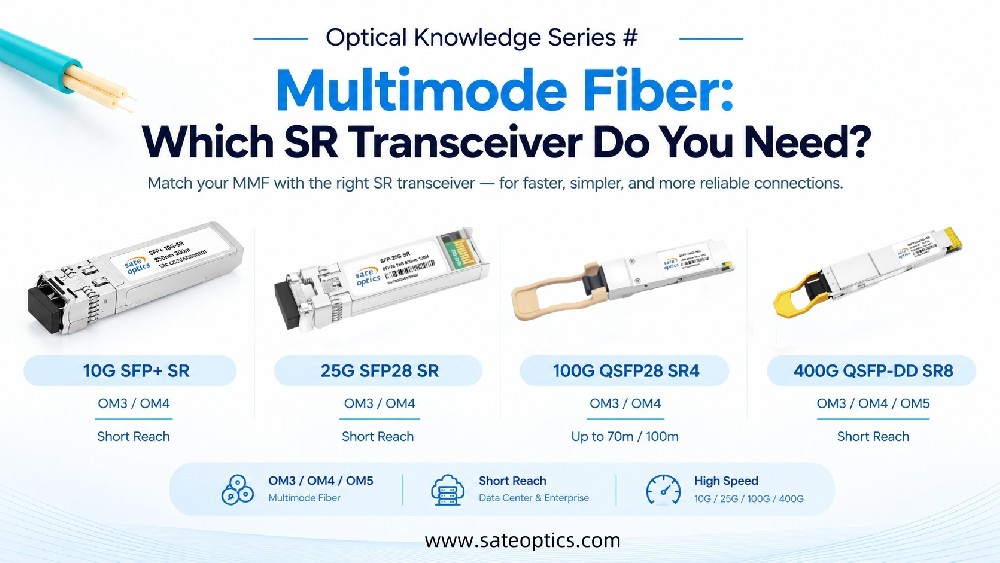
40G QSFP+ SR4 = 4 × 10G lanes
100G QSFP28 SR4 = 4 × 25G lanes
400G QSFP-DD SR8 = 8 × 50G lanes
Each lane requires its own optical fiber.
An LC connector only supports one transmit fiber and one receive fiber, which isn't enough for these parallel optical architectures.
That's why an MPO connector is required.
Does Every 100G Optical Module Use MPO?
No.
The connector depends on the transmission technology.
MPO-based modules
These modules use parallel optics.
Examples include:
40G QSFP+ SR4
100G QSFP28 SR4
400G QSFP-DD SR8
800G OSFP SR8
These modules are primarily designed for short-distance multimode fiber applications inside data centers.
LC Duplex modules
These modules use WDM (Wavelength Division Multiplexing) technology.
Examples include:
100G QSFP28 LR4
100G QSFP28 FR1
100G QSFP28 CWDM4
400G QSFP-DD LR4
400G QSFP-DD FR4
Instead of using multiple fibers, they transmit several wavelengths through one duplex fiber pair.
MPO vs LC: What's the Difference?
| Feature | MPO | LC Duplex |
|---|---|---|
| Fiber Count | 8/12/16+ fibers | 2 fibers |
| Transmission | Parallel optics | Duplex/WDM |
| Typical Distance | Short reach | Medium & Long reach |
| Best For | High-density data centers | Enterprise & Metro networks |
| Common Speeds | 40G, 100G, 400G, 800G | 1G, 10G, 25G, 100G LR4 |
Neither connector is "better."
The right choice depends entirely on your network architecture.
Typical Application Scenarios
AI Computing Clusters
Large AI clusters require thousands of high-speed interconnects between GPU servers and switches.
MPO cabling provides the density needed while simplifying cable management.
Cloud Data Centers
Cloud providers deploy thousands of 100G, 400G and 800G links.
Using MPO trunk cabling reduces installation time and improves airflow inside racks.
Enterprise Data Centers
Organizations upgrading from 10G to 100G often choose MPO-based SR4 solutions for short-distance switch-to-switch and switch-to-server connections.
Spine-Leaf Networks
Modern spine-leaf architectures depend on high-density optical connectivity.
MPO enables compact cabling while supporting future bandwidth upgrades.
How to Choose Between MPO and LC
Ask yourself three questions:
Is the transmission distance short?
If yes, SR4 modules with MPO are often the most cost-effective choice.
Are you using multimode fiber?
Most SR4 modules require OM3 or OM4 multimode fiber with MPO connectors.
Is your network based on WDM optics?
If you're deploying LR4, FR4 or CWDM4 modules, LC duplex connectors are typically the correct option.
Popular Optical Transceiver Models
At Sate Optics, we provide compatible optical transceivers for major networking brands.
Popular models include:
40G QSFP+ SR4
40G QSFP+ LR4
100G QSFP28 SR4
100G QSFP28 LR4
100G QSFP28 CWDM4
100G QSFP28 FR1
400G QSFP-DD SR8
400G QSFP-DD DR4
400G QSFP-DD FR4
400G QSFP-DD LR4
800G OSFP SR8
800G QSFP-DD SR8
All modules are available with high compatibility for major networking platforms and undergo rigorous quality testing before shipment.
Frequently Asked Questions (FAQ)
Is MPO faster than LC?
No. The connector itself doesn't determine speed. MPO simply allows multiple fibers to transmit data simultaneously, making it suitable for parallel optical applications.
Why do SR4 modules use MPO while LR4 uses LC?
SR4 uses multiple parallel optical lanes, while LR4 combines multiple wavelengths over a single duplex fiber pair using WDM technology.
Can I connect an MPO module to an LC cable?
Not directly. You'll need an MPO-to-LC breakout cable or cassette, depending on your network design.
Are MPO connectors only used for data centers?
No. While they are most common in data centers, MPO cabling is also used in AI clusters, cloud computing, telecom backbones and high-density enterprise networks.
Which fiber is used with MPO?
Most short-reach MPO applications use OM3 or OM4 multimode fiber, although single-mode MPO solutions are also widely used for DR4 and PSM applications.
Conclusion
MPO connectors aren't designed to replace LC connectors.
They solve a different challenge—supporting the high fiber counts required by modern high-speed Ethernet.
As networks continue evolving toward 400G, 800G and AI-driven infrastructure, understanding the differences between MPO and LC helps you choose the right optical transceiver, cabling system and network architecture for your deployment.
Ready to Build Your High-Speed Optical Network?
Whether you're deploying 40G, 100G, 400G or 800G infrastructure, choosing the right optical transceiver and cabling solution is essential for performance and scalability.
Sate Optics offers a complete range of compatible optical transceivers, MPO cables, DACs and AOCs for data centers, cloud providers, telecom operators and enterprise networks.
Contact our team today for expert advice, OEM/ODM services and competitive pricing tailored to your project.
MPO Cable
MPO Connector
MPO vs LC
100G QSFP28 SR4
40G QSFP+ SR4
400G QSFP-DD SR8
800G OSFP SR8
Optical Transceiver
Data Center Cabling
High-Speed Fiber Network
Parallel Optics
WDM Optical Module
AI Data Center
Cloud Networking
Fiber Optic Connectivity
Previous:Understanding Optical Transceiver Types: SFP, SFP+, QSFP28, QSFP-DD, QSFP112 & OSFP Explained
Next:Why Do Ethernet Cables Have Different Colors? Does Cable Color Affect Network Speed?