
Can You Mix Different SFP Brands in the Same Switch? Complete Guide
2026-08-07 18:01:39
Can You Mix Different SFP Brands in the Same Switch?
What Network Engineers Should Know Before Deploying Multi-Vendor Optical Modules
A common question from network engineers and IT teams:
“Can I use different SFP brands in the same switch?”
For example:
A Cisco-compatible SFP module on one port
A generic SFP module on another port
A Juniper-compatible optical module on another port
Will the switch work normally?
The short answer:
Yes, in many cases different SFP brands can work together in the same network environment.
However, the important factor is not simply the brand name printed on the module.
Optical communication depends on whether the technical specifications match.
Before connecting different optical modules, engineers should check:
✅ Data rate
✅ Wavelength
✅ Transmission distance
✅ Fiber type
✅ Module compatibility
Do Different SFP Brands Really Matter?
One of the biggest misunderstandings in optical networking is:
“Different brands cannot communicate with each other.”
This is not always true.
In real-world networks, many companies operate multi-vendor environments.
For example:
Different switch vendors
Different generations of hardware
Different optical suppliers
The optical link does not recognize the logo on the transceiver.
It depends on:
Optical parameters
Electrical interface
Firmware/coding information
Network equipment support
A properly manufactured compatible optical transceiver can operate in many enterprise, telecom, and data center applications.
5 Things to Check Before Mixing SFP Modules
1. Check the Data Rate: 1G, 10G, 25G, 100G Are Different
The first rule:
Both optical modules must support the same network speed.
Examples:
✅ 1G SFP ↔ 1G SFP
✅ 10G SFP+ ↔ 10G SFP+
✅ 25G SFP28 ↔ 25G SFP28
✅ 100G QSFP28 ↔ 100G QSFP28
But:
❌ 10G SFP+ ↔ 25G SFP28
❌ 40G QSFP+ ↔ 100G QSFP28
Although some modules may have the same physical connector size, the communication standard is different.
The result:
Link down
No signal
Port error
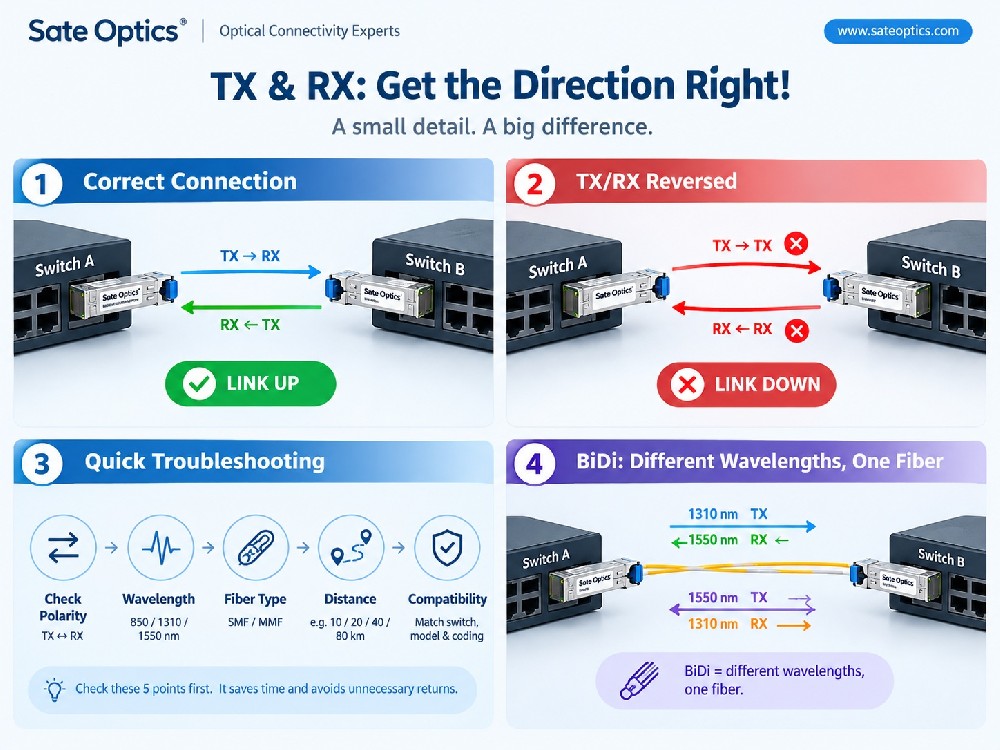
2. Match the Optical Wavelength
Fiber communication uses light wavelengths to transmit data.
Common wavelengths include:
850nm
Usually used for:
Multimode fiber
Short-distance connections
Data center links
Example:
SFP-10G-SR
1310nm
Commonly used for:
Single-mode fiber
Medium-distance transmission
Example:
SFP-10G-LR
1550nm
Used for:
Longer-distance transmission
Telecom networks
DWDM systems
Example:
10G DWDM SFP+
Incorrect wavelength matching can cause:
❌ No optical signal
❌ Low receive power
❌ Unstable connection
3. Verify Transmission Distance and Optical Budget
A common mistake is choosing modules only by connector type.
For example:
Both modules may be:
SFP+
LC connector
Single-mode fiber
But their optical performance can be completely different.
Examples:
10G SFP+ SR
Multimode fiber
Around 300m (depending on fiber type)
10G SFP+ LR
Single-mode fiber
Up to 10km
10G SFP+ ER/ZR
Longer-distance applications
Using a short-distance module for a long link may result in:
Weak optical power
Packet errors
Link instability
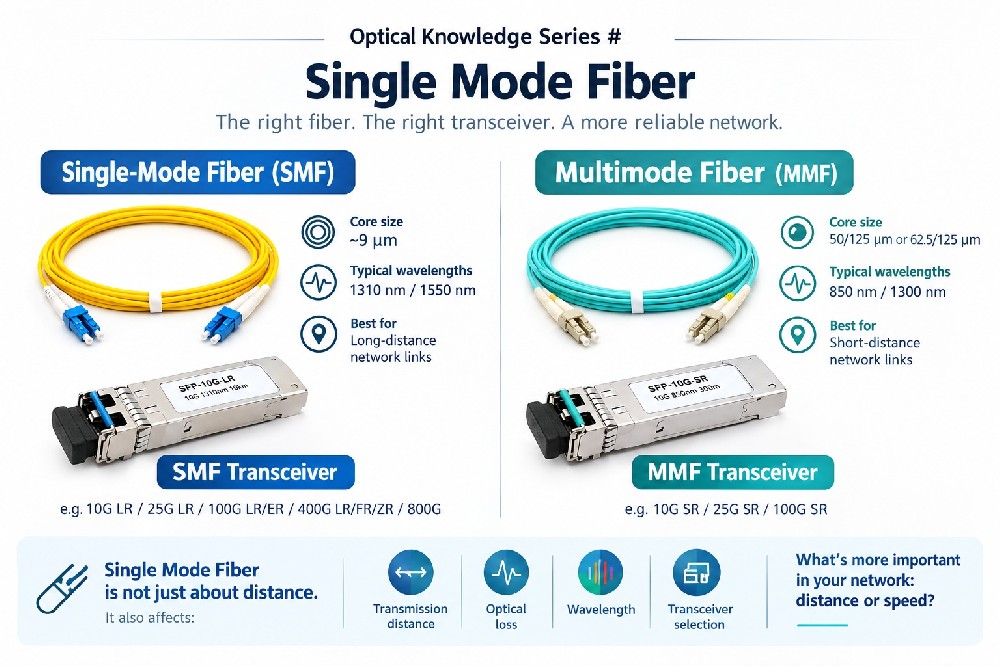
4. Confirm Fiber Type: SMF vs MMF
Fiber type is another critical factor.
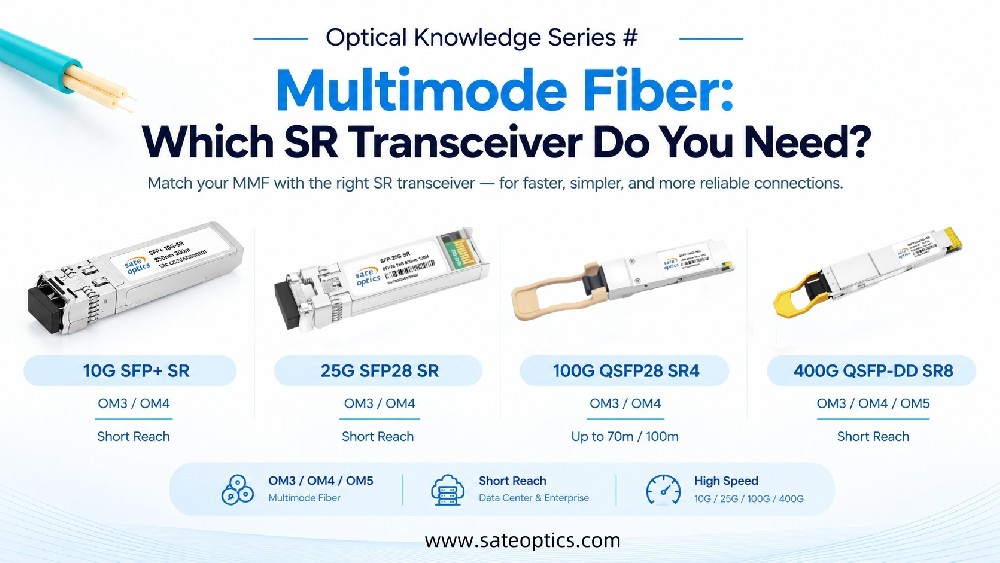
Multimode Fiber (MMF)
Common with:
850nm wavelength
OM3 / OM4 fiber
Short-distance data center links
Typical modules:
SFP-10G-SR
SFP-25G-SR
QSFP-100G-SR4
Single-mode Fiber (SMF)
Common with:
1310nm
1550nm
Longer transmission distances
Typical modules:
SFP-10G-LR
SFP-25G-LR
QSFP-100G-LR4
Using the wrong fiber type can lead to poor performance or complete link failure.
5. Consider Module Coding and Equipment Compatibility
Modern switches may check information stored inside optical modules.
Examples:
Vendor information
EEPROM data
Digital diagnostics
Module identification
This is why compatible optical modules need proper programming for specific equipment platforms.
A high-quality compatible transceiver should provide:
✅ Correct coding
✅ Stable communication
✅ Accurate DOM monitoring
✅ Reliable performance
Common SFP Mixing Scenarios
Scenario 1:
Two Different Compatible SFP+ Modules
Example:
10G SFP+ LR from Supplier A
10G SFP+ LR from Supplier B
If specifications match:
✅ Same speed
✅ Same wavelength
✅ Same fiber type
✅ Same distance
The link can work normally.
Scenario 2:
SFP+ and SFP28 Mixed Together
Example:
10G SFP+ module
25G SFP28 module
Usually:
❌ Not compatible
Because the electrical signaling and data rate are different.
Scenario 3:
BiDi SFP Modules
BiDi modules require special attention.
Unlike traditional duplex SFPs, BiDi uses one fiber.
The wavelength pairing must be correct.
Example:
Side A:
TX 1310nm / RX 1550nm
Side B:
TX 1550nm / RX 1310nm
Wrong pairing:
❌ No link
Recommended SFP Modules for Different Applications
Enterprise Networks
Common choices:
1.25G SFP SX/LX
10G SFP+ SR/LR
25G SFP28 SR/LR
Applications:
Campus networks
Office networks
Enterprise switches
Data Center Networks
Common choices:
10G SFP+
25G SFP28
40G QSFP+
100G QSFP28
400G QSFP-DD
Applications:
Server connections
Spine-leaf architecture
Cloud infrastructure
Telecom Networks
Common choices:
CWDM SFP
DWDM SFP+
Long-distance LR/ER/ZR modules
Applications:
Metro networks
ISP networks
Optical transport systems
FAQ: Mixing Different SFP Brands
Q1: Can I use different SFP brands in the same switch?
Yes. Different SFP brands can work together if the technical specifications and equipment compatibility requirements are satisfied.
Q2: Does the SFP brand affect optical performance?
The brand itself is not the main factor.
Performance depends on:
Optical quality
Manufacturing process
Testing standards
Compatibility programming
Q3: Can I mix 10G SFP+ and 25G SFP28?
No.
They use different data rates and electrical standards.
Q4: Can I mix SR and LR modules?
Generally no.
SR uses multimode fiber and 850nm wavelength.
LR uses single-mode fiber and 1310nm wavelength.
Q5: How can I choose the correct compatible SFP module?
Check:
Switch model
Required speed
Fiber type
Distance
Wavelength
Compatibility coding
Final Thoughts
Different SFP brands can work together.
The key question is not:
“Are these modules from the same company?”
The better question is:
“Do these modules have matching technical specifications?”
For modern networks, multi-vendor optical environments are becoming more common.
Choosing the right optical transceiver requires understanding:
Speed + Wavelength + Distance + Fiber Type + Compatibility
Need Help Choosing the Right SFP Module?
At Sate Optics, we provide compatible optical transceivers from 1G to 800G, including:
SFP
SFP+
SFP28
QSFP+
QSFP28
QSFP-DD
OSFP
Solutions include:
Data centers
Enterprise networks
Telecom operators
ISP networks
Our optical modules are tested for compatibility, reliability, and stable network performance.
Contact Sate Optics today for optical transceiver selection support and customized OEM solutions.
1.25G SFP SX/LX
SFP-10G-SR
SFP-10G-LR
SFP-10G-ER
SFP-25G-SR
SFP-25G-LR
QSFP-40G-SR4
QSFP-100G-SR4
QSFP-100G-LR4
QSFP-DD-400G
OSFP-800G
Previous:Why Do Some Network Switches Have Empty SFP Ports? The Real Reason Behind Modular Network Design
Next:800G vs 1.6T Optical Transceivers: AI Data Center Guide