
800G vs 1.6T Optical Transceivers: AI Data Center Guide
2026-08-11 22:01:40
800G vs 1.6T Optical Transceivers: What Is Changing in AI Data Centers?
Optical Knowledge Series — AI Data Center Connectivity
AI data centers are moving faster than traditional data center networks.
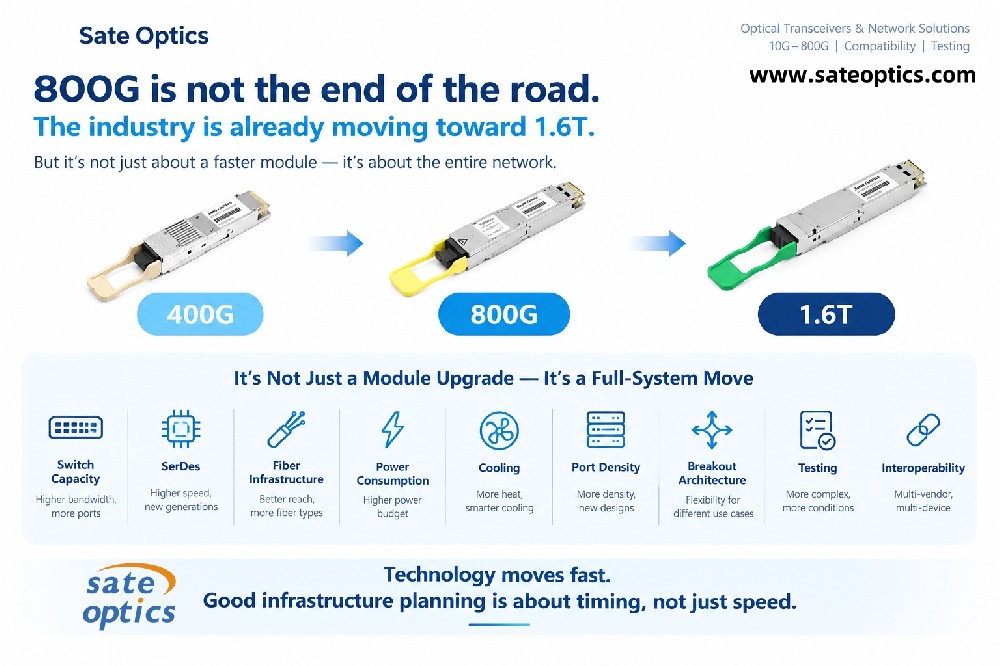
A few years ago, 400G optical transceivers were considered high-speed connectivity. Today, 800G is becoming increasingly important for AI and hyperscale data center networks, while the industry is already moving toward the next step: 1.6T optical transceivers.
But what is actually changing from 800G to 1.6T?
Is 1.6T simply twice as fast as 800G?
And more importantly:
Does every AI data center really need 1.6T?
The short answer is no.
The right choice depends on the switch architecture, lane speed, link distance, power budget, fiber infrastructure and overall network design.
800G vs 1.6T: The Basic Difference
The easiest way to understand the evolution is:
400G → 800G → 1.6T
Each generation increases the amount of data that can move through a single optical interface.
A common first-generation 800G architecture uses:
8 × 100G lanes = 800G
The next-generation 1.6T architecture can use:
8 × 200G lanes = 1.6T
This is why 200G per lane is becoming such an important term in next-generation AI networking.
The change is not simply about doubling the total bandwidth.
It is also about increasing the amount of bandwidth that can be carried by each lane.
For example, Coherent's 1.6T-DR8 demonstration uses eight electrical lanes and eight optical lanes, with each lane operating at 200Gbps. Source Photonics has also announced 800G and 1.6T products based on 200G-per-lane PAM4 technology.
Why Is the Industry Moving Beyond 800G?
The biggest reason is simple:
AI clusters are getting bigger.
Modern AI workloads require large numbers of GPUs and accelerators to exchange huge amounts of data.
The network connecting those systems therefore becomes increasingly important.
If the compute capacity keeps increasing while network bandwidth does not keep pace, the network can become a bottleneck.
That creates pressure for:
Higher bandwidth per port
Higher bandwidth density
Lower power per transmitted bit
Higher-speed switch interfaces
More efficient rack and data center connectivity
This is where 800G and 1.6T optical transceivers become important.
The optical transceiver is no longer just a small component inside a switch.
For large AI clusters, it becomes part of the overall performance and power-efficiency equation.
What Does 200G per Lane Actually Mean?
This is one of the most important concepts to understand.
You may see terms such as:
100G/lane
and
200G/lane
These describe the data rate carried by each individual electrical or optical lane.
A simplified comparison looks like this:
800G
8 × 100G = 800G
1.6T
8 × 200G = 1.6T
The move toward 200G/lane allows the network to achieve much higher total bandwidth without simply doubling the number of physical lanes.
This is important for high-density AI switches.
It can help increase bandwidth while keeping the physical architecture manageable.
Of course, actual optical module architectures can vary.
For example, some 800G solutions use four optical wavelengths at 200G each, while their electrical interface can still be based on 8 × 100G lanes. Coherent demonstrated this type of architecture as an evolution toward 200G optical lanes.
So when comparing an optical transceiver, don't look only at the headline:
800G
or
1.6T
Look deeper into the lane architecture.
400G → 800G → 1.6T: What Is Really Evolving?
The evolution can be simplified like this:
400G
→ Higher-speed data center connectivity
→ Widely used for high-performance networking
800G
→ Higher bandwidth density
→ Important for AI and hyperscale networks
→ Increasing use of PAM4 and multi-lane architectures
1.6T
→ 2× the aggregate bandwidth of 800G
→ Increasing focus on 200G/lane
→ Designed for next-generation high-density AI networking
This does not mean that every network needs to upgrade immediately.
In fact, one of the biggest mistakes a buyer can make is assuming:
“Newer and faster must be better.”
It isn't always.
Will 1.6T Immediately Replace 800G?
No.
800G and 1.6T are likely to coexist for some time.
Why?
Because upgrading optical transceivers is not an isolated decision.
A network needs the entire ecosystem to support the required speed.
For example:
1. Switch port speed
A 1.6T optical module cannot magically turn an 800G switch port into a 1.6T port.
The switch ASIC, port architecture and optical interface all need to support the required configuration.
2. Electrical lane speed
If the platform is designed around 100G/lane, moving to a native 200G/lane architecture may require a different platform.
3. Power and thermal budget
Higher-speed optics can create additional power and thermal considerations.
In a large AI switch populated with many high-speed optical modules, even a small difference in power per module can become significant at system level.
4. Fiber infrastructure
The optical module is only one part of the link.
Fiber type, connector configuration, breakout architecture and transmission distance still matter.
5. Cost
If an 800G solution already meets the application's requirements, moving to 1.6T simply because it is newer may not make economic sense.
Where Will 1.6T Optical Transceivers Be Used?
The strongest demand is expected in environments where extremely high bandwidth density is required.
1. AI GPU Clusters
AI training and inference systems can contain large numbers of GPUs and accelerators.
These systems need high-speed communication between computing resources.
In such environments, higher-speed optical connectivity can help provide the bandwidth required by the overall architecture.
2. AI Data Center Switch-to-Switch Connections
Large AI fabrics rely heavily on high-capacity switches.
As switch bandwidth increases, the optical interfaces connecting those switches also need to evolve.
This is one of the areas where 800G and eventually 1.6T can become particularly important.
3. Rack-to-Rack Connectivity
AI infrastructure is not limited to communication inside a single server.
Data also needs to move between racks.
High-speed optical links can provide the bandwidth and reach required for these connections.
4. Hyperscale Data Centers
Large cloud and hyperscale operators continuously look for higher network capacity and better bandwidth density.
The transition from 800G toward 1.6T is therefore particularly relevant to these environments.
The broader market is already seeing increasing attention on optical interconnects as AI infrastructure scales.
800G or 1.6T: Which One Should You Choose?
There is no universal answer.
Instead, start with the network architecture.
Ask these questions:
Question 1: What is the switch port speed?
If the switch does not support 1.6T, there is little reason to purchase a 1.6T module simply because it is faster.
Question 2: Does the platform support 200G/lane?
This is one of the key technical considerations when moving toward next-generation 1.6T connectivity.
Question 3: What is the required link distance?
A short-reach AI data center connection may use a very different optical design from a longer data center interconnect.
Always match the transceiver to the actual fiber distance.
Question 4: What is the power budget?
Don't look only at transmission speed.
For high-density switches, module power and thermal management can become important design considerations.
Question 5: Do you need breakout?
Some network architectures may require connections such as:
800G → 2 × 400G
or other breakout configurations.
The switch, transceiver and cabling architecture must support the intended topology.
Question 6: What is the total cost?
The cheapest module is not necessarily the lowest-cost solution.
Consider:
Transceiver + fiber + cabling + switch compatibility + power + future upgrade requirements
together.
Common 800G and 1.6T Optical Transceiver Keywords
When researching next-generation data center optics, you may come across product terms such as:
800G OSFP DR8
800G OSFP FR8
800G OSFP 2×FR4
800G 200G/lane optical transceiver
800G PAM4 optical transceiver
1.6T OSFP DR8
1.6T DR8 optical transceiver
1.6T 200G/lane optical transceiver
1.6T PAM4 optical transceiver
800G AOC
800G DAC
1.6T AOC
1.6T data center optical transceiver
These keywords are useful when comparing products, architectures and compatibility requirements.
However, a product name alone is not enough.
Always check the complete specification.
800G vs 1.6T: A Simple Way to Think About It
If you remember only one thing from this article, remember this:
800G is not becoming obsolete simply because 1.6T exists.
Instead:
400G → 800G → 1.6T
is an evolution in network bandwidth density.
And the transition is increasingly connected to:
100G/lane → 200G/lane
The important question is therefore not:
“Which module is faster?”
It is:
“Which optical architecture matches my network?”
That is a much better purchasing question.
What About 3.2T?
If 1.6T is the next step, what comes after it?
The industry is already researching and demonstrating technologies beyond 1.6T, including higher-speed lane architectures and future 3.2T solutions.
But that does not mean network operators should start replacing 800G equipment immediately.
Technology roadmaps move faster than real-world network deployments.
For most buyers, the practical priority should be:
Choose the right technology for today's architecture while keeping the next upgrade cycle in mind.
That approach can prevent expensive upgrades that don't actually solve a current network problem.
FAQ: 800G vs 1.6T Optical Transceivers
Is 1.6T twice as fast as 800G?
Yes. In aggregate bandwidth, 1.6T provides approximately twice the capacity of 800G.
However, the more important technical change is the move toward higher lane rates, including 200G per lane.
What does 200G per lane mean?
It means each individual electrical or optical lane can carry approximately 200Gbps of signaling capacity.
A common 1.6T-DR8 architecture uses eight 200G lanes to reach 1.6Tbps total capacity.
Will 1.6T replace 800G?
Not immediately.
800G will continue to be useful where existing switch architectures, costs, power budgets and bandwidth requirements make it the appropriate solution.
1.6T is more relevant to next-generation high-density AI and hyperscale deployments.
Is 1.6T only for AI data centers?
AI data centers are one of the major target applications, but the technology can also be relevant to other high-bandwidth data center and networking environments.
What form factor is used for 1.6T optical transceivers?
OSFP is one important form factor for 1.6T optical transceivers.
For example, 1.6T-DR8 demonstrations have been developed in the OSFP form factor.
The exact form factor and implementation should always be checked against the target switch platform.
What should I check before buying a 1.6T transceiver?
At minimum, check:
Switch compatibility, port speed, lane architecture, form factor, fiber type, transmission distance, power consumption, breakout requirements and coding/compatibility requirements.
Is 800G still a good choice in 2026?
Yes.
The emergence of 1.6T does not make 800G irrelevant.
For many applications, 800G may still provide the right balance between bandwidth, compatibility, power consumption and cost.
Final Thoughts
The transition from 800G to 1.6T is not simply a race for a bigger number.
It represents a broader change in how high-speed optical connectivity is designed for AI infrastructure.
The key concepts to understand are:
800G
1.6T
200G/lane
PAM4
OSFP
DR8
AI data center connectivity
But the most important lesson is even simpler:
Don't choose 1.6T just because it's faster. Choose it when your switch, server architecture, link distance and power budget actually require it.
For network engineers and procurement teams, understanding the architecture behind the number can help avoid compatibility problems and unnecessary upgrade costs.
Need Help Choosing 800G or 1.6T Optics?
Planning an AI data center upgrade?
Not sure whether 800G or 1.6T optical transceivers are right for your switch architecture?
Sate Optics can help you compare compatible optical solutions based on:
Switch and platform compatibility
Transmission distance
Fiber type
Form factor
Breakout requirements
Power considerations
800G / 1.6T architecture
Tell us your switch model, required distance and target bandwidth, and we can help you identify the appropriate optical transceiver configuration.
[Contact Sate Optics for optical transceiver compatibility support]
Previous:Can You Mix Different SFP Brands in the Same Switch? Complete Guide
Next:FEC in 400G and 800G Optical Transceivers | Sate Optics