
FEC in 400G and 800G Optical Transceivers | Sate Optics
2026-08-13 17:29:55
FEC: The Technology Helping 400G Links Stay Reliable
As network speeds continue to move from 100G to 400G and 800G, optical networking is becoming more than a question of choosing a faster transceiver.
A common question is:
Can the transceiver support the required speed?
But for high-speed Ethernet, another question matters:
How does the complete link maintain reliable data transmission at that speed?
One important technology to understand is FEC — Forward Error Correction.
FEC is especially relevant when evaluating high-speed links that use PAM4 signaling, including many 400G and 800G optical networking applications.
But there is one important point to remember:
FEC does not make an incompatible optical transceiver compatible.
To build a reliable high-speed link, FEC needs to be considered together with the transceiver, switch, NIC, fiber, signaling, and overall link architecture.
What Is FEC in Optical Networking?
FEC stands for Forward Error Correction.
In simple terms, FEC adds redundant information to transmitted data. The receiver can use this information to detect and correct certain errors without requiring the sender to retransmit the data.
A simplified view is:
Data → FEC Processing → Transmission → Error Detection/Correction → Data Recovery
This can improve the robustness of high-speed communication systems.
However, FEC is not a replacement for proper optical design.
A link can still fail because of:
Incorrect transceiver compatibility
Insufficient optical power
Poor fiber connections
Excessive insertion loss
Incorrect host configuration
Unsupported signaling or interface requirements
This is why FEC should be considered as one part of the complete link design.
Why Does FEC Matter for 400G and 800G?
As Ethernet speeds increase, the electrical and optical signaling requirements become more demanding.
Many modern high-speed interfaces use PAM4 (Pulse Amplitude Modulation 4) rather than traditional NRZ signaling.
PAM4 uses four signal levels to transmit more bits per symbol, helping increase data throughput.
The trade-off is that the signal has smaller voltage margins between levels and can be more sensitive to noise and signal impairments.
This makes understanding the complete transmission system increasingly important.
For engineers evaluating:
100G optical transceivers
400G QSFP-DD modules
400G OSFP modules
800G OSFP modules
High-speed DAC and AOC connections
FEC and signaling should be included in the compatibility check.
FEC Is Not the Same as Transceiver Compatibility
This is one of the most important points for buyers.
A module may be labeled:
400G
but that does not automatically mean it will work in every 400G port.
Likewise, an 800G OSFP module cannot be evaluated only by its transmission speed.
Before purchasing a high-speed optical transceiver, check the complete system:
Switch → Transceiver → Fiber → Transceiver → Switch
or, depending on the architecture:
Switch → Transceiver → Fiber → Transceiver → NIC
The host platform, interface implementation, signaling, FEC requirements, fiber infrastructure, and transceiver specifications all need to work together.
What Should You Check Before Buying a 400G or 800G Transceiver?
Instead of checking only price and transmission distance, use this simple checklist.
1. Port Speed
Is the system using:
100G
400G
800G
The transceiver must match the actual port and application requirements.
2. Form Factor
Common high-speed form factors include:
QSFP28
QSFP-DD
OSFP
The physical form factor is only the starting point. Host compatibility still needs to be verified.
3. Signaling
Check whether the application uses:
NRZ
PAM4
This becomes particularly important when evaluating modern 400G and 800G platforms.
4. FEC Requirements
Check the FEC requirements of the complete interface or platform.
Do not assume that every 100G, 400G, or 800G application uses exactly the same FEC implementation.
5. Switch and NIC Compatibility
A transceiver must be compatible with the host equipment.
Check:
Switch model
NIC model
Port type
Supported interface
Firmware or platform requirements
6. Fiber Infrastructure
The optical module is only one part of the link.
Also verify:
Fiber type
Connector
MPO/MTP or duplex LC
Link distance
Insertion loss
Polarity
7. Link Type
Depending on the application, you may encounter:
SR / DR / FR / LR
The correct choice depends on the required distance, fiber infrastructure, and network architecture.
Common 100G, 400G and 800G Optical Transceiver Keywords
For buyers researching high-speed optical modules, some common product and technology terms include:
100G
100G QSFP28
100G QSFP28 SR4
100G QSFP28 LR4
100G QSFP28 DR
100G optical transceiver
400G
400G QSFP-DD
400G QSFP-DD SR8
400G QSFP-DD DR4
400G QSFP-DD FR4
400G OSFP
400G optical transceiver
800G
800G OSFP
800G OSFP 2x400G
800G optical transceiver
800G data center optics
These keywords represent different applications and form factors. Always verify the exact platform and optical requirements before selecting a module.
FEC in Real-World Applications
Understanding FEC becomes much more useful when looking at actual network deployments.
Application 1: AI and Data Center Networks
AI clusters and modern data centers are driving demand for higher-speed connections.
A typical architecture may involve:
Switch → 400G/800G Optics → Fiber → Switch
At these speeds, engineers need to consider more than just bandwidth.
PAM4 signaling, FEC requirements, fiber infrastructure, host compatibility, and optical performance all become part of the deployment decision.
Application 2: 400G Spine-and-Leaf Networks
In a modern data center, 400G links can be used between spine and leaf switches.
For example:
400G QSFP-DD → Fiber → 400G QSFP-DD
Depending on the required distance and infrastructure, different optical types such as SR, DR, FR, or LR may be considered.
FEC should be checked as part of the complete interface specification rather than treated as a standalone feature.
Application 3: 800G Data Center Upgrades
As data center networks move toward 800G, the optical module becomes part of a much larger system.
Engineers may need to evaluate:
800G OSFP + PAM4 + FEC + Fiber + Switch/NIC Compatibility
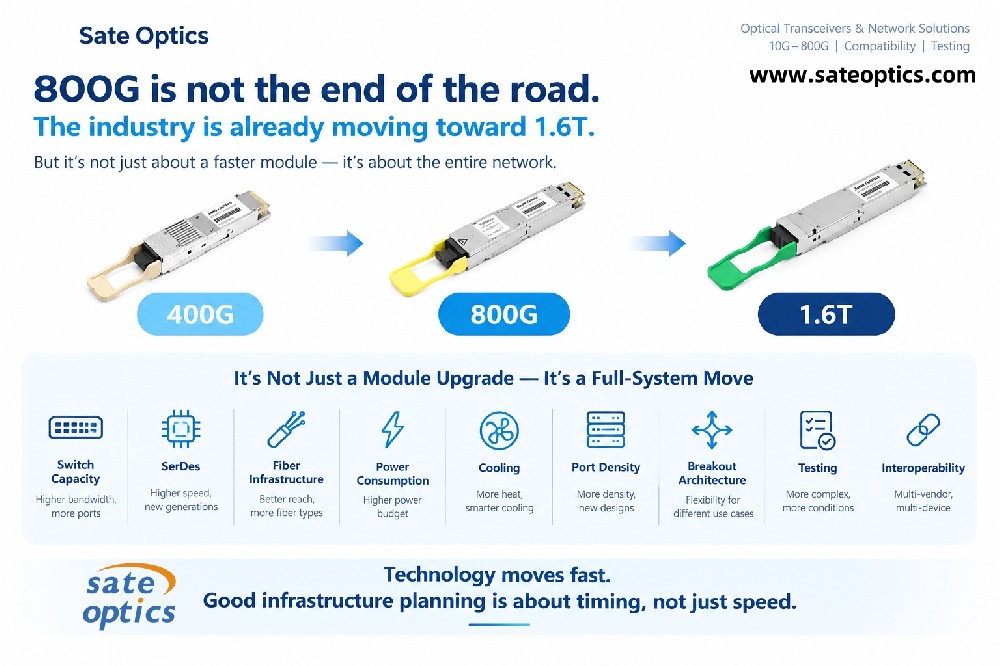
This is why upgrading from 400G to 800G should be treated as a system-level decision, rather than simply replacing one transceiver with a faster model.
FEC vs. Link Reliability: What Should You Remember?
The simplest way to remember the concept is:
FEC helps recover certain transmission errors.
But:
FEC does not fix a poorly designed or incompatible optical link.
A reliable high-speed network requires the complete chain to work together:
FEC + Signaling + Optics + Fiber + Host Compatibility
That is the key takeaway when evaluating 400G and 800G optical transceivers.
Frequently Asked Questions
Does every 400G optical transceiver use FEC?
FEC requirements depend on the specific Ethernet interface, PHY, host platform, and implementation. Do not assume that every 400G module uses the same FEC configuration.
Does FEC improve optical transmission distance?
FEC can improve the system's ability to tolerate certain transmission errors, but it should not be treated as a simple method for extending the specified optical reach of a transceiver.
The module's rated reach and optical specifications still need to be respected.
Is FEC the same as PAM4?
No.
PAM4 is a signaling technology, while FEC is an error-correction mechanism.
They solve different problems but can work together in high-speed networking systems.
Can FEC fix an incompatible 400G transceiver?
No.
FEC does not solve problems such as incorrect form factor, unsupported host platform, incompatible interface, incorrect fiber type, or vendor compatibility issues.
What should I check when buying a 400G QSFP-DD?
Check the:
Switch or NIC model
Port specification
QSFP-DD compatibility
Optical type
Transmission distance
Fiber type
Connector
Signaling
FEC requirements
What should I check when upgrading from 400G to 800G?
Do not evaluate the optical module alone.
Check the complete path:
Switch → Optics → Fiber → Optics → Switch/NIC
The host platform, form factor, signaling, FEC requirements, fiber infrastructure, and optical specifications should all be validated before deployment.
Final Takeaway
When moving from:
100G → 400G → 800G
higher bandwidth brings more system-level considerations.
FEC is an important part of understanding high-speed Ethernet, particularly when PAM4-based interfaces are involved.
But the most important lesson is simple:
Don't evaluate the optic alone. Evaluate the link.
Before purchasing a 400G QSFP-DD, 400G OSFP, or 800G OSFP transceiver, check:
Speed + Signaling + FEC + Optics + Fiber + Compatibility
That approach can help reduce unexpected link issues during deployment.
Looking for Compatible 100G, 400G or 800G Optical Transceivers?
At Sate Optics, we provide compatible optical transceiver solutions for data center, enterprise, telecom, and high-speed networking applications.
Whether you are evaluating 100G QSFP28, 400G QSFP-DD, 400G OSFP, or 800G OSFP, our team can help you check the key specifications before deployment.
Need help choosing the right optical transceiver for your switch, NIC, distance, and fiber infrastructure?
👉 Contact Sate Optics for compatibility and product selection support.
Previous:800G vs 1.6T Optical Transceivers: AI Data Center Guide
Next:How to Choose the Right Network Switch: 7 Key Factors to Check