
AOC vs Fiber Optic Cable: What's the Difference and Which Should You Choose?
2026-07-09 11:32:25
AOC vs Fiber Optic Cable: Which Is Better for Your Network?
Understand the real difference between Active Optical Cables (AOC) and fiber optic cables with optical transceivers, and learn which solution is best for your data center, enterprise network, or AI infrastructure.
As we shared our recent article comparing DAC vs Fiber Cable, many network engineers asked an interesting question:
"Why not compare AOC and Fiber Optic Cable instead?"
It's a great question—and one that often causes confusion.
Since both solutions use optical fiber, many people assume they're essentially the same. In reality, they're designed very differently and serve different networking needs.
This guide explains the differences in simple terms and helps you choose the right solution for your application.
What Is an Active Optical Cable (AOC)?
An Active Optical Cable (AOC) is an integrated cabling solution that combines:
Optical transceivers
Optical fiber
Factory-terminated connectors
Everything is permanently assembled and tested before shipment.
Unlike traditional fiber links, the optical modules cannot be removed or replaced separately. Simply connect both ends to your switches, servers, or storage devices, and the link is ready to operate.
Advantages of AOC
Plug-and-play installation
No transceiver compatibility concerns
Factory-tested performance
Lightweight and flexible
Lower power consumption than many copper solutions over longer short-distance links
What Is a Fiber Optic Cable?
A fiber optic cable is simply a passive transmission medium.
To establish a network connection, you also need an optical transceiver installed at each end.
A complete fiber link consists of:
Optical transceiver
Fiber optic patch cable
Optical transceiver
Because the cable and transceivers are separate components, each can be selected, upgraded, or replaced independently.
The Biggest Difference
The easiest way to remember it is:
AOC = Optical Transceivers + Fiber (Built Together)
Fiber Solution = Optical Transceivers + Fiber (Separate Components)
Both transmit data through optical fiber.
The real difference is whether the optical transceivers are integrated into the cable or installed separately.
AOC vs Fiber Optic Cable Comparison
| Feature | Active Optical Cable (AOC) | Fiber Cable + Optical Transceivers |
|---|---|---|
| Installation | Plug and Play | Requires separate module installation |
| Flexibility | Fixed assembly | Highly flexible |
| Cable Length | Fixed | Easily customized |
| Module Replacement | Not replaceable | Replaceable independently |
| Future Upgrades | Limited | Easy to upgrade |
| Maintenance | Replace entire cable | Replace only the faulty component |
When Should You Choose AOC?
AOC is often the better choice when you need:
Short-distance switch-to-switch connections
Server-to-switch links
High-density data center racks
HPC clusters
AI server interconnects
Fast deployment with minimal installation effort
Because everything is factory assembled, AOCs reduce installation time and eliminate module compatibility concerns.
When Should You Choose Fiber Optic Cable?
Fiber cables with optical transceivers are usually the better option if you need:
Longer transmission distances
Flexible cable routing
Easy hardware upgrades
Independent replacement of modules
Different wavelengths or transmission standards
Scalable enterprise or telecom networks
This approach offers greater flexibility for growing networks and long-term maintenance.
Typical Applications
AOC Applications
AI clusters
GPU server connectivity
Data centers
High-performance computing (HPC)
Top-of-Rack (ToR) switching
Storage Area Networks (SAN)
Fiber Cable + Optical Transceiver Applications
Enterprise campus networks
Metropolitan Area Networks (MAN)
Telecommunications
ISP backbone networks
Cloud data centers
Long-distance interconnection
Industrial Ethernet
Popular AOC and Optical Transceiver Models
Depending on your network speed, common products include:
Active Optical Cable (AOC)
800G OSFP AOC
800G QSFP-DD AOC
Optical Transceivers
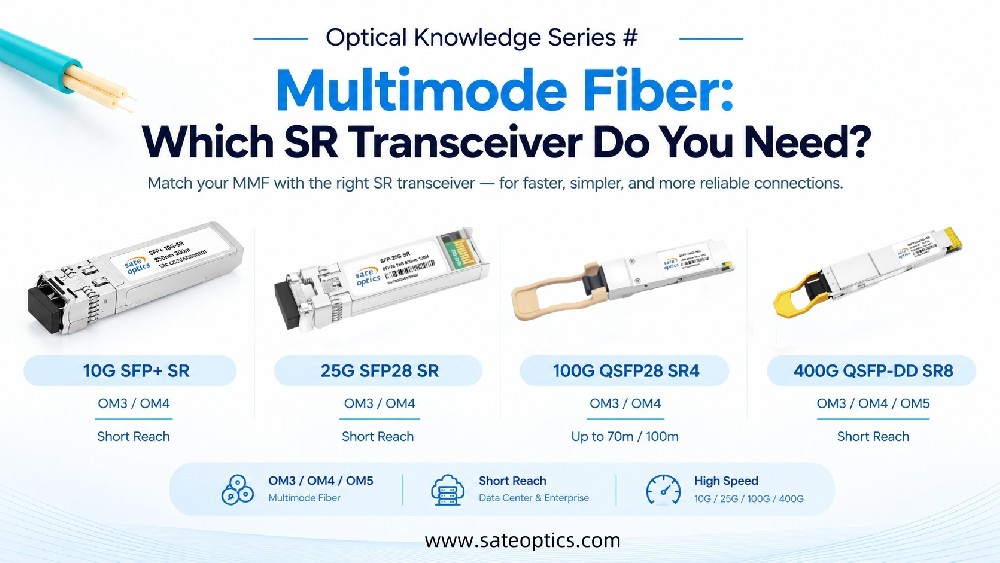
10G SFP+ SR
10G SFP+ LR
25G SFP28 SR
25G SFP28 LR
40G QSFP+ SR4
100G QSFP28 SR4
100G QSFP28 LR4
100G QSFP28 DR
400G QSFP-DD SR8
400G QSFP-DD DR4
400G QSFP-DD FR4
400G QSFP-DD LR4
800G QSFP-DD SR8
800G OSFP SR8
These products support Ethernet speeds from 10G to 800G for modern data center and enterprise networking.
Frequently Asked Questions
Is an AOC just a fiber optic cable?
No.
An AOC contains both optical transceivers and optical fiber inside one integrated assembly, while a standard fiber optic cable is only the passive cable.
Can I replace the optical module on an AOC?
No.
Because the transceivers are permanently attached to the cable, the entire AOC must be replaced if one end becomes damaged.
Which solution is more flexible?
Fiber optic cables with separate optical transceivers provide greater flexibility because you can choose different cable lengths, wavelengths, and transmission distances while replacing modules independently.
Which solution is better for data centers?
Both are widely used.
Many short-reach rack connections use AOCs for their simplicity, while structured cabling and longer interconnections commonly use fiber optic cables with optical transceivers.
Does AOC support 100G, 400G, and 800G Ethernet?
Yes.
Modern AOCs are available for 10G, 25G, 40G, 100G, 200G, 400G, and 800G Ethernet applications.
Final Thoughts
Choosing between AOC and fiber optic cable with optical transceivers isn't about which technology is better—it's about selecting the right solution for your network architecture.
If you value plug-and-play simplicity and fast deployment, an Active Optical Cable (AOC) is an excellent choice.
If your priority is flexibility, scalability, easier maintenance, and future upgrades, a fiber optic cable with separate optical transceivers is usually the better long-term investment.
Understanding this distinction can help reduce deployment costs, simplify maintenance, and improve network reliability.
Need Help Choosing the Right Optical Connectivity Solution?
Whether you're deploying 10G, 25G, 100G, 400G, or 800G Ethernet, Sate Optics offers high-quality compatible optical transceivers, Active Optical Cables (AOCs), Direct Attach Copper (DAC) cables, and customized optical connectivity solutions for data centers, AI infrastructure, enterprise networks, and telecom applications.
Contact our technical team today to discuss your project requirements or request a compatibility recommendation for your networking equipment.
Previous:Understanding High-Speed Transceiver Tests | 100G & 400G Optical Modules
Next:The Future of 400G in Data Centers | Choosing the Right 400G Optical Transceiver