
Data Center Copper vs Fiber: RJ45, DAC, AOC & Optical Transceivers
2026-08-12 17:16:00
Data Center Copper vs Fiber: How to Choose Between RJ45, DAC, AOC and Optical Transceivers
Not every data center connection needs fiber. The right choice depends on distance, bandwidth, port type, deployment cost, and future network plans.
When engineers plan a data center network, one question often comes up:
Should we use copper or fiber?
The answer is not as simple as “fiber is faster, so fiber is better.”
Modern data centers commonly use a combination of RJ45 copper, Direct Attach Copper (DAC), Active Optical Cables (AOC), and optical transceivers with fiber.
Each technology solves a different connectivity problem.
The key is choosing the right solution for the right link.
Copper vs Fiber in Data Centers: What Is the Difference?
Copper and fiber are not competing technologies in every situation.
They are often complementary.
Copper-based connectivity is attractive for short-distance links because it can be simple, cost-effective, and easy to deploy.
Fiber becomes increasingly valuable when the network requires longer reach, higher bandwidth, greater flexibility, or a clear path for future upgrades.
A simple way to think about it is:
RJ45 → Simple Ethernet connectivity
DAC → Very short high-speed connections
AOC → High-speed connections with more reach
Optical Transceiver + Fiber → Distance, bandwidth, and flexibility
1. RJ45: When Simple Connectivity Is Enough
RJ45 remains useful in many data center environments.
It is particularly common for:
Network management
Server management ports
Legacy Ethernet equipment
Enterprise networking
Short-distance 1G and 10G connections
Applications where existing copper infrastructure is already available
For these applications, installing optical transceivers may provide little practical benefit.
If a management connection only requires 1G Ethernet, there may be no reason to deploy a high-speed optical solution.
When should you consider RJ45?
Choose RJ45 when:
The required bandwidth is relatively low
The distance is short
The equipment already supports Ethernet copper
Simplicity is more important than maximum density
Existing copper cabling can be reused
The important point is:
Don't over-engineer a simple connection.
2. DAC: A Practical Choice for Short-Distance High-Speed Links
DAC (Direct Attach Copper) is widely used for short-distance data center connections.
A DAC cable integrates the cable and transceiver interfaces into one assembly.
Typical applications include:
Server-to-switch connections
Switch-to-switch connections
Top-of-Rack (ToR) networking
High-density racks
10G, 25G, 40G and 100G short-distance links
One of the biggest advantages of DAC is simplicity.
Instead of purchasing separate optical transceivers and fiber patch cables, the connection is delivered as one cable assembly.
Why do data centers use DAC?
DAC can offer:
Lower initial connectivity cost
Low latency
Simple installation
Fewer components
Convenient short-distance deployment
However, DAC has an important limitation:
Distance.
It is designed primarily for short connections. As the distance increases, optical connectivity becomes more attractive.
Typical DAC applications
A common example is:
Server → DAC → ToR Switch
For a rack where the server and switch are physically close, DAC can be an efficient solution.
3. AOC: When DAC Is Not Enough
AOC (Active Optical Cable) sits between traditional copper cabling and separate optical transceiver solutions.
An AOC integrates optical components and fiber into one cable assembly.
This makes AOC attractive when you want:
More reach than typical DAC applications
High-speed connectivity
Cleaner cable management
High-density data center deployment
A relatively simple plug-and-play installation
Typical applications include:
40G data center links
100G server-to-switch connections
200G high-speed connections
400G data center connectivity
High-density switch interconnects
A simple comparison is:
DAC = copper + short distance
AOC = optical + integrated cable
Optical transceiver = optical + separate fiber + greater flexibility
4. Optical Transceivers + Fiber: When Flexibility Matters
This is where optical connectivity becomes particularly valuable.
With separate optical transceivers and fiber patch cables, engineers can select the module and fiber according to the required:
Data rate
Distance
Wavelength
Fiber type
Connector
Network architecture
Common optical transceiver form factors include:
SFP
SFP+
SFP28
QSFP+
QSFP28
QSFP56
QSFP-DD
OSFP
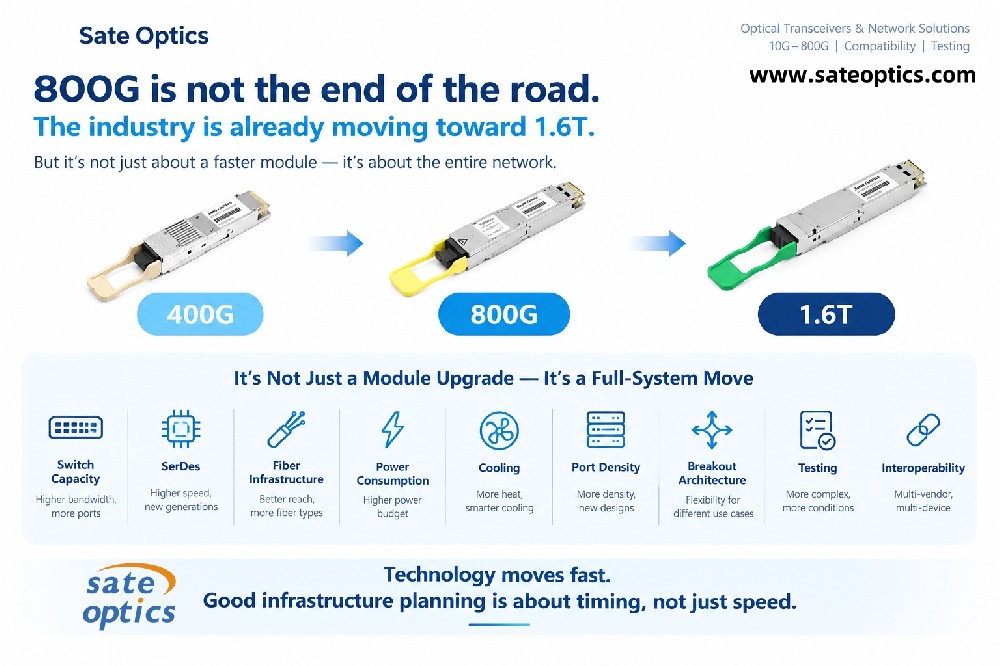
And common network speeds range from:
1G → 10G → 25G → 40G → 100G → 200G → 400G → 800G
For example:
10G → SFP+
25G → SFP28
100G → QSFP28
400G → QSFP-DD
800G → QSFP-DD / OSFP, depending on the platform and implementation
Cisco's current transceiver portfolio, for example, includes 25G, 100G, 400G and QSFP-DD optical solutions, illustrating how pluggable optics continue to support different network architectures and speeds.
Optical Transceiver Types: SR, LR, ER, ZR and BiDi
Choosing the correct form factor is only part of the decision.
The optical type also matters.
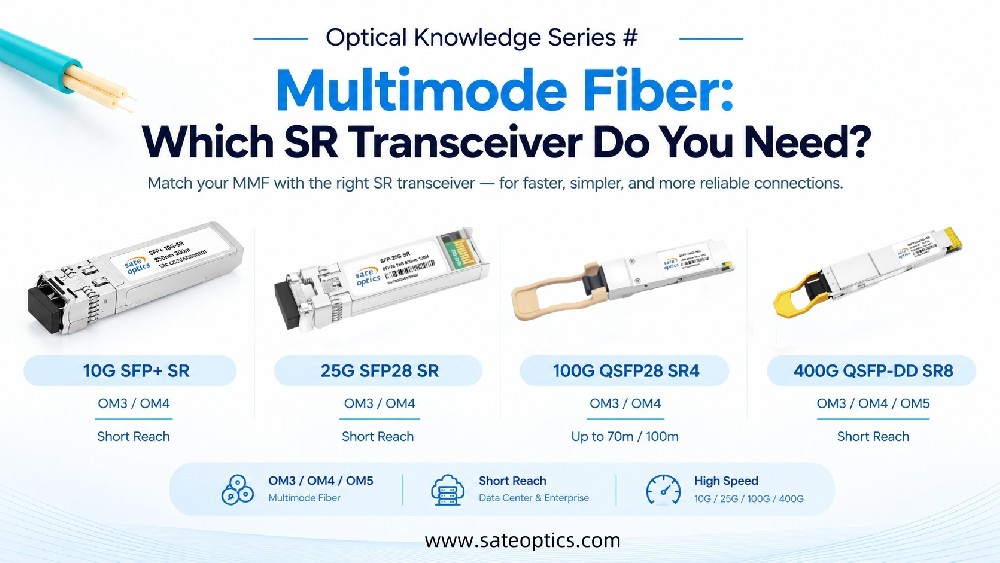
SR — Short Reach
Typically used for short-distance connections over multimode fiber.
Common applications include:
Server-to-switch
ToR-to-leaf
Data center interconnects within a facility
For example, 100G QSFP28 SR4 is commonly paired with MPO/MTP multimode fiber for short-distance 100G data center links.
LR — Long Reach
LR modules are designed for longer-distance optical links and are commonly associated with single-mode fiber.
Typical applications include:
Data center buildings
Campus networks
Longer switch-to-switch connections
Telecom and enterprise networks
ER / ZR — Extended Reach
When the link extends beyond typical SR or LR applications, ER and ZR solutions may become relevant.
The exact reach depends on the module specification, fiber infrastructure, optical budget, and network environment.
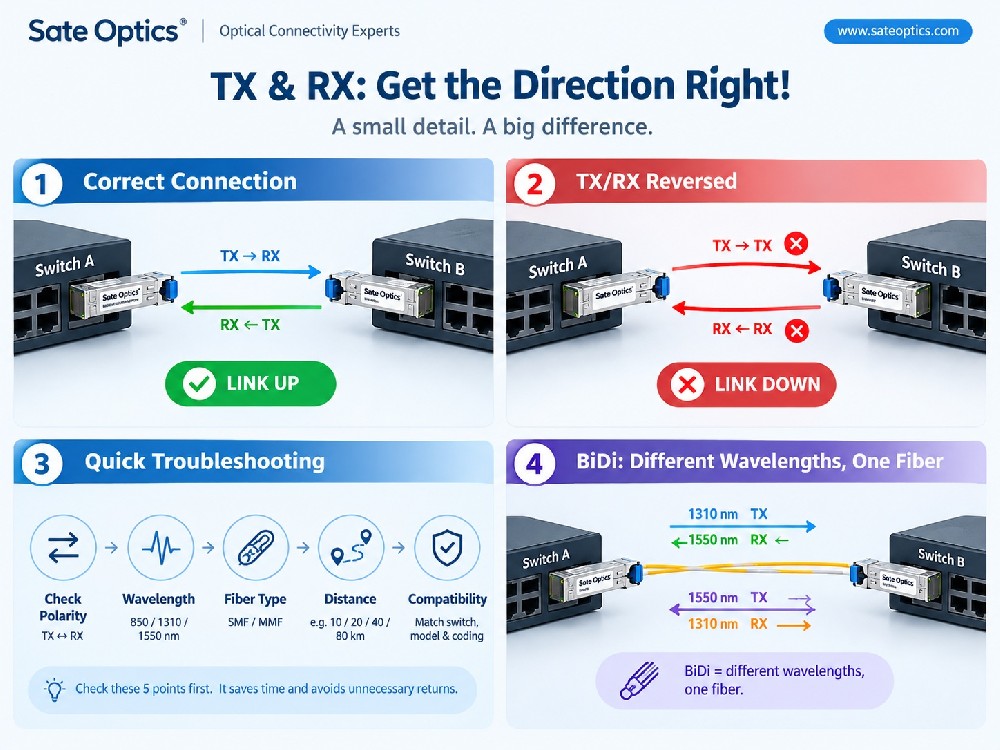
BiDi — When Fiber Resources Are Limited
BiDi optical transceivers are useful when a network needs bidirectional communication over a single fiber.
Instead of using separate fibers for transmit and receive, BiDi modules use different wavelengths for the two directions.
This can be particularly useful when fiber resources are limited.
Copper or Fiber? Use This Simple Decision Guide
If you are selecting a connection for a new data center deployment, start with these five questions.
1. How far is the link?
Very short?
→ Consider RJ45 or DAC
Short but requiring more reach?
→ Consider AOC
Longer distance?
→ Consider Optical Transceiver + Fiber
2. What bandwidth do you need?
1G / management?
→ RJ45 may be enough.
10G / 25G?
→ RJ45, DAC, AOC, SFP+ or SFP28 depending on the application.
100G?
→ QSFP28, DAC, AOC or fiber-based optics.
400G / 800G?
→ High-speed optical solutions become increasingly important, depending on the architecture.
3. What ports are available?
Always check the actual switch and server interface.
For example:
SFP+ port → typically designed around 10G connectivity
SFP28 port → commonly used for 25G
QSFP28 port → commonly used for 100G
QSFP-DD port → commonly used for high-speed 200G/400G and other supported configurations
Do not select a cable or transceiver based only on the advertised data rate.
The host port, module, cable, coding, and network configuration all need to match.
4. What is your upgrade plan?
A connection that works today may become a limitation later.
For example:
10G → 25G → 100G
If a data center is already planning a major bandwidth upgrade, optical connectivity may provide greater flexibility for future expansion.
5. What is the total cost?
Don't compare only:
DAC price vs optical module price
Consider the complete connectivity cost:
Transceiver + Fiber + Cable Management + Installation + Maintenance + Future Upgrade
The cheapest component is not always the cheapest network solution over its entire lifecycle.
Common Data Center Applications
The choice between copper and fiber becomes much clearer when looking at real-world scenarios.
Application 1: Server Management
Server → RJ45 → Management Switch
For management traffic, RJ45 can be a simple and practical choice.
Application 2: Server-to-ToR at Short Distance
Server → DAC → ToR Switch
DAC is often attractive when servers and switches are located within the same rack or very close to each other.
Application 3: High-Density Short-Distance Networking
Switch → AOC → Switch
AOC can provide an integrated optical connection while reducing the need to manage separate transceivers and patch cables.
Application 4: 100G Data Center Network
Switch → QSFP28 → Fiber → QSFP28 → Switch
100G QSFP28 solutions are widely used in data center networks, with different optical types available for different distances and fiber infrastructures.
Application 5: 400G Data Center Upgrade
400G Switch → QSFP-DD → Fiber → QSFP-DD → 400G Switch
As network bandwidth increases, QSFP-DD and other high-speed optical form factors become important options for data center upgrades. Cisco, for example, continues to maintain 400G QSFP-DD solutions in its current transceiver portfolio.
Common Model Keywords for Data Center Connectivity
When searching for compatible network connectivity, engineers and buyers commonly use model-level keywords such as:
10G Optical Transceivers
SFP-10G-SR
SFP-10G-LR
SFP-10G-ER
SFP+ 10G SR
SFP+ 10G LR
25G Optical Transceivers
SFP-25G-SR
SFP-25G-LR
SFP28 25G SR
SFP28 25G LR
100G Optical Transceivers
QSFP-100G-SR4-S
QSFP-100G-LR4-S
QSFP-100G-ER4-S
QSFP28 100G SR4
QSFP28 100G LR4
400G / 800G Optical Connectivity
400G QSFP-DD
400G QSFP-DD SR8
400G QSFP-DD FR4
800G QSFP-DD
800G OSFP
800G SR8
High-Speed Cable Keywords
25G SFP28 DAC
100G QSFP28 DAC
100G QSFP28 AOC
400G QSFP-DD AOC
400G QSFP-DD DAC
For compatible optics, always verify the exact switch model, port type, firmware requirements, coding/compatibility requirements, fiber type, connector, and transmission distance before purchasing.
FAQ: Data Center Copper vs Fiber
Is fiber always better than copper in a data center?
No.
Fiber is excellent for longer distances and high-bandwidth applications, but copper can be more practical for short-distance or management connections.
The best solution depends on the application.
Is DAC copper or fiber?
DAC stands for Direct Attach Copper.
The cable uses copper conductors and is designed for short-distance high-speed connections.
Is AOC copper or fiber?
AOC stands for Active Optical Cable.
It uses optical fiber and integrated optical components inside the cable assembly.
What is better for short-distance data center connections: DAC or fiber?
It depends on the required bandwidth, distance, port type, cable density, and future upgrade plans.
DAC is often attractive for very short links because of its simplicity and cost structure.
Fiber-based solutions can provide greater flexibility and reach.
When should I choose an optical transceiver instead of DAC?
Consider optical transceivers when you need:
Longer transmission distance
Higher bandwidth
Different fiber types
Different connector configurations
Greater network flexibility
Easier future changes to the optical link
Can DAC and optical transceivers be used in the same data center?
Absolutely.
A modern data center can use RJ45, DAC, AOC, and optical transceivers simultaneously.
The goal is not to eliminate one technology.
The goal is to use the most appropriate technology for each connection.
How do I choose between SFP28, QSFP28 and QSFP-DD?
Start with the required data rate and the switch/server port.
For example:
SFP28 → commonly used for 25G
QSFP28 → commonly used for 100G
QSFP-DD → commonly used for higher-speed applications such as 200G/400G, depending on the platform
Always confirm the equipment manufacturer's supported optics and cabling before deployment.
Final Thoughts: The Best Data Center Network Uses the Right Technology
The copper-versus-fiber discussion doesn't need a winner.
In a well-designed data center, both technologies can have a place.
Use RJ45 when simplicity and compatibility are the priority.
Use DAC for short, high-speed connections.
Use AOC when you need integrated optical connectivity with more reach.
Use optical transceivers and fiber when distance, bandwidth, flexibility, and scalability become more important.
The real question isn't:
“Copper or fiber?”
It is:
“What is the right connectivity solution for this specific link?”
That shift in thinking can help data center teams reduce unnecessary costs today while keeping the network ready for tomorrow's bandwidth requirements.
Why Choose Sate Optics for Data Center Connectivity?
At Sate Optics, we focus on optical connectivity solutions for data centers, telecom networks, enterprise networks, ISPs, and system integrators.
Our portfolio covers connectivity from 1G to 800G, including:
Optical Transceivers
SFP / SFP+ / SFP28
QSFP+ / QSFP28 / QSFP56
QSFP-DD
OSFP
DAC Cables
AOC Cables
MPO/MTP Fiber Connectivity
CWDM / DWDM Solutions
We also support OEM-compatible and customized optical solutions for different network platforms.
Before ordering, our team can help verify:
Switch model → Port type → Transceiver → Fiber → Distance → Compatibility
This can help reduce the risk of choosing a technically correct module that is not suitable for the actual network environment.
Ready to choose the right connectivity solution?
Explore Sate Optics' optical connectivity solutions or contact our team with your switch model, port type, required speed, distance, and quantity.
We'll help you identify the most suitable combination of transceivers, DAC, AOC, and fiber connectivity for your application.
Sate Optics | Optical Connectivity Experts
Previous:Optical Transceiver Troubleshooting: 5 Checks for Reliable Network Links
Next:Optical Transceiver Selection Guide: How to Choose the Right Module | Sate Optics