
SFP vs SFP+ vs SFP28 vs QSFP+ vs QSFP28 — What’s the Difference?
2026-04-07 18:21:17
SFP vs SFP+ vs SFP28 vs QSFP+ vs QSFP28 — What’s the Difference? (Buyer Guide)
When selecting the right optical transceivers for your network, understanding the differences between SFP, SFP+, SFP28, QSFP+, and QSFP28 is crucial. These terms represent various types of fiber optic modules that can impact your network’s speed, scalability, and overall performance.
In this guide, we’ll break down the key differences, help you determine which module is right for your specific needs, and give you the insights you need to make an informed purchasing decision.
What Are Optical Transceivers?
An optical transceiver is a device used to transmit and receive data signals over fiber optic cables. These modules are essential for networking devices like switches, routers, servers, and storage equipment. They come in different form factors and support different speeds, distances, and use cases.
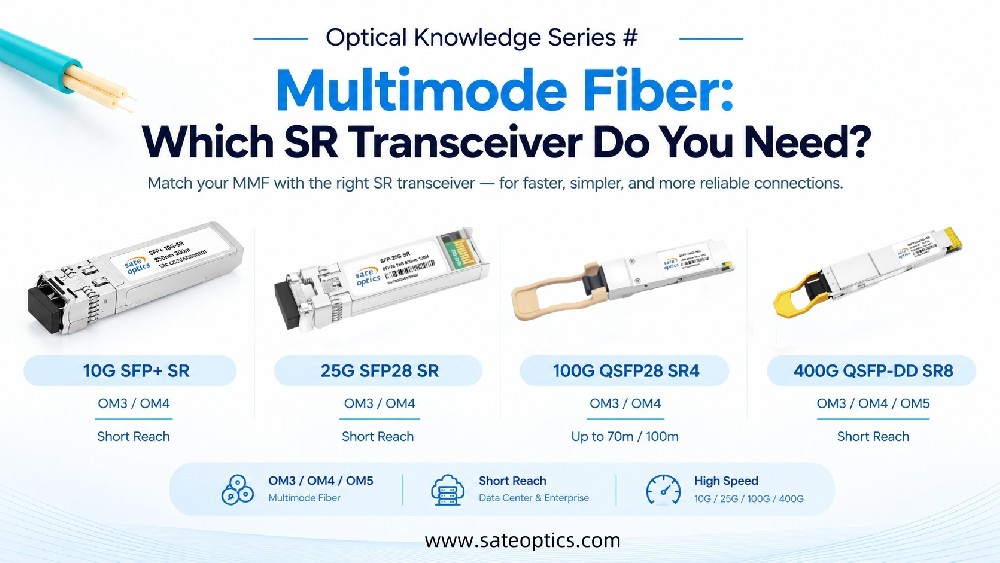
The common types of optical transceivers include SFP, SFP+, SFP28, QSFP+, and QSFP28. Each of these modules is designed for different applications, with varying performance and capabilities.
1. SFP (Small Form-factor Pluggable)
Speed: Up to 1 Gbps (Gigabit Ethernet)
Common Use Cases: Gigabit Ethernet (1G), fiber channel, SDH/SONET systems
Distance: Typically up to 100km, depending on the fiber type (Single-mode or Multi-mode)
Why it matters:
SFP modules are suitable for 1G network applications. If your network requires lower speeds and operates within smaller distance ranges, SFP is a cost-effective option for your setup.
2. SFP+ (Small Form-factor Pluggable Plus)
Speed: 10 Gbps
Common Use Cases: 10 Gigabit Ethernet, fiber channel, Data Center Interconnects
Distance: Up to 80km (depends on the fiber type and wavelength)
Why it matters:
SFP+ modules are the go-to solution for 10G Ethernet and fiber channel connections. They offer faster speeds than standard SFP modules and are ideal for applications where higher throughput is required, such as high-performance computing or data center networks.
3. SFP28 (Small Form-factor Pluggable 28)
Speed: 25 Gbps
Common Use Cases: 25 Gigabit Ethernet, Data Centers, Cloud Networking
Distance: Up to 30km (depending on the fiber and other factors)
Why it matters:
SFP28 modules are optimized for 25G applications, which is becoming the new standard in data centers and cloud networking. They offer a balance between cost and performance, making them an excellent choice for next-gen data center upgrades.
4. QSFP+ (Quad Small Form-factor Pluggable Plus)
Speed: 40 Gbps (4x 10 Gbps channels)
Common Use Cases: 40 Gigabit Ethernet, Infiniband, Data Center Backbone
Distance: Up to 100m (depends on the fiber type and wavelength)
Why it matters:
QSFP+ modules are designed for high-speed 40G applications, commonly used in data center backbones and high-performance computing (HPC) environments. They offer high bandwidth with multiple channels in one module, making them ideal for scalable high-performance networks.
5. QSFP28 (Quad Small Form-factor Pluggable 28)
Speed: 100 Gbps (4x 25 Gbps channels)
Common Use Cases: 100 Gigabit Ethernet, Data Center Backbone, High-Performance Computing (HPC)
Distance: Up to 80km, depending on the fiber and application
Why it matters:
QSFP28 is designed for 100G applications, a critical solution for the increasing demands in data centers and network infrastructure. With 4x 25G channels, it provides ultra-high bandwidth, making it ideal for large-scale network deployments and AI-driven workloads.
SFP vs SFP+ vs SFP28 vs QSFP+ vs QSFP28 — Which One is Right for You?
Key Considerations When Choosing an Optical Module:
Speed Requirements:
If you need 1G, SFP is your choice.
For 10G applications, opt for SFP+.
For 25G speed, SFP28 is ideal.
For 40G and 100G, consider QSFP+ and QSFP28, respectively.
Distance:
Shorter distances (up to 300m) often use SFP or SFP+ modules.
For longer distances, QSFP+ and QSFP28 modules may be more appropriate.
Future-Proofing:
If you’re looking to scale your network for the future, investing in SFP28 or QSFP28 will provide better flexibility as data demands continue to rise.
Cost vs. Performance:
Lower-speed modules like SFP are more cost-effective but may not provide the future scalability needed for modern data center deployments. Higher-speed modules like QSFP28 may be a larger upfront investment but offer superior performance and capacity for larger-scale environments.
Frequently Asked Questions (FAQ)
1. What is the main difference between SFP and SFP+?
SFP supports speeds up to 1G, while SFP+ supports 10G speeds, making it ideal for faster network environments.
2. Can I use an SFP module in an SFP+ port?
No, SFP modules are not compatible with SFP+ ports. SFP+ requires higher-speed transceivers designed to handle 10G connections.
3. When should I use QSFP+ over SFP+?
QSFP+ is ideal for 40G applications, such as high-performance computing and data center backbones, whereas SFP+ is suited for 10G Ethernet.
4. What’s the benefit of using QSFP28?
QSFP28 supports 100G speeds, providing massive bandwidth, which is perfect for large-scale data centers, AI workloads, and high-density network environments.
5. How do I choose between SFP28 and QSFP28?
If your network needs 25G connections, SFP28 is a more cost-effective solution. If you require 100G speeds for massive scalability, QSFP28 is the better choice.
Conclusion:
Choosing the right optical transceiver for your network is essential for optimal performance and future scalability. Whether you need 1G, 10G, 25G, 40G, or 100G, understanding the differences between SFP, SFP+, SFP28, QSFP+, and QSFP28 will help you make an informed decision that aligns with your network’s speed, distance, and capacity requirements.
By selecting the right optics for your network, you can ensure seamless scalability, reduce operational costs, and future-proof your infrastructure for evolving data needs.
#SFP #SFP+ #SFP28 #QSFP+ #QSFP28 #OpticalTransceivers #DataCenterSolutions #NetworkUpgrade #FiberOpticModules #Networking #Telecom
Next:Optical Links: What Specs Don’t Tell You About SFP Modules