
What Is Inside an SFP Transceiver? How Optical Modules Work in Fiber Networks?
2026-03-24 10:50:15
What’s Actually Happening Inside an SFP Transceiver?
SFP (Small Form-factor Pluggable) transceivers are small components, but they play a critical role in modern fiber optic networking.
From data centers and telecom networks to enterprise infrastructure, SFP modules are responsible for enabling high-speed data transmission over fiber links.
But what exactly happens inside an SFP transceiver?
Understanding how these modules work can help network engineers and IT buyers make better decisions when selecting, deploying, or troubleshooting optical connectivity solutions.
How an SFP Transceiver Works
At its core, an SFP transceiver performs one essential function:
👉 Converting electrical signals into optical signals — and back again
1. Electrical-to-Optical Signal Conversion
Inside every SFP module:
Electrical signals from a switch or router are converted into optical (light) signals
These light signals travel through a fiber optic cable
At the receiving end, another SFP converts the light back into electrical signals
This process enables high-speed, long-distance data transmission with minimal signal loss.
2. Key Internal Components of an SFP Transceiver
Although compact, an SFP module contains several high-precision components:
Laser (Transmitter)
The laser generates the optical signal used to transmit data.
Different wavelengths are used depending on the application
Determines transmission distance and performance
Photodetector (Receiver)
The photodetector converts incoming light signals back into electrical signals.
Critical for signal accuracy
Affects link stability and error rates
EEPROM Chip
Each SFP contains an EEPROM (Electrically Erasable Programmable Read-Only Memory) chip.
This chip stores key information such as:
Data rate (1G / 10G / 25G / 100G and beyond)
Wavelength
Vendor compatibility data
Diagnostic monitoring information (DDM/DOM)
This allows the SFP to communicate properly with network devices.
3. Why Speed and Performance Matter
SFP transceivers are designed for specific speeds and applications.
Common types include:
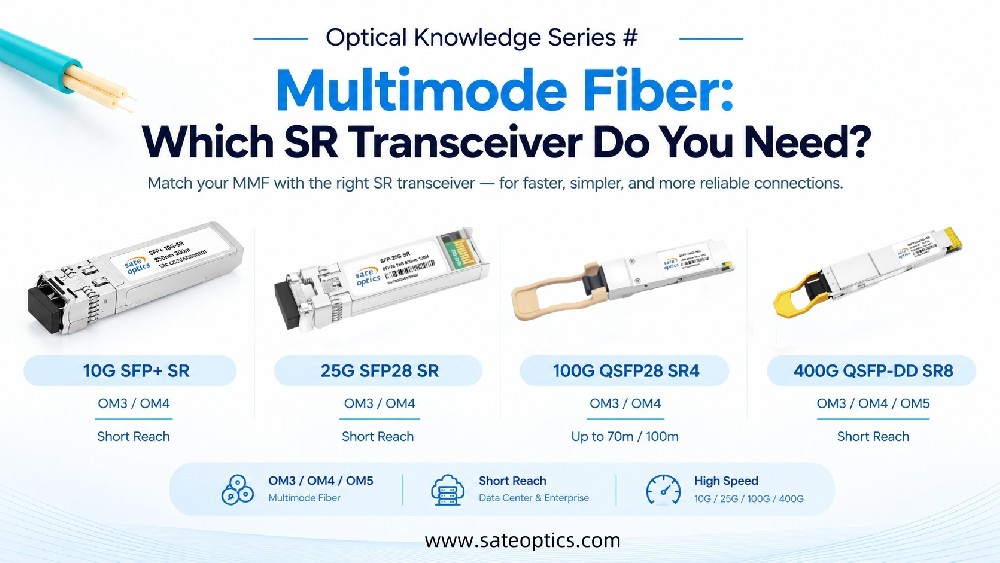
1G SFP
10G SFP+
25G SFP28
100G QSFP28
Each module is optimized for:
Transmission distance
Signal integrity
Power consumption
Using the correct module ensures optimal network performance and stability.
4. Hot-Swappable and Plug-and-Play Design
Most modern SFP modules are hot-swappable, meaning:
They can be installed or replaced without shutting down the system
This minimizes network downtime
The EEPROM enables plug-and-play compatibility, allowing the device to automatically recognize the module.
5. Flexibility Across Different Network Environments
SFP transceivers are highly adaptable and support different fiber types:
Single-Mode Fiber (SMF): Long-distance transmission
Multi-Mode Fiber (MMF): Short-distance, high-speed connections
This flexibility allows network designers to build scalable and efficient infrastructures.
Why Understanding SFP Transceivers Matters
For network engineers and IT decision-makers, understanding how SFP modules work helps:
Select the right optical transceiver for each application
Avoid compatibility issues
Improve network performance and stability
Reduce long-term maintenance and troubleshooting costs
Even small component choices can have a significant impact on overall network reliability.
Choosing the Right SFP Transceiver for Your Network
Not all optical modules are created equal.
Factors to consider include:
Compatibility with network equipment
Transmission distance and wavelength
Environmental conditions
Long-term reliability
At Sate Optics, we provide a full range of optical transceivers from 1G to 800G, designed for:
Data centers
Telecom networks
Enterprise infrastructure
All modules are tested for compatibility with platforms from vendors such as Cisco Systems, Juniper Networks, Arista Networks, and Hewlett Packard Enterprise.
We support:
Fast global delivery
Stable supply
Technical consultation for deployment and compatibility
Common Questions About SFP Transceivers (FAQ)
What is an SFP transceiver used for?
An SFP transceiver is used to connect network devices such as switches and routers to fiber optic or copper cables for data transmission.
How does an SFP transmit data?
It converts electrical signals into optical signals using a laser and sends them through fiber, then converts them back using a photodetector.
Are SFP modules interchangeable?
Many SFP modules are interchangeable, but compatibility depends on the device and vendor coding.
What is the difference between SMF and MMF SFP?
SMF SFPs are used for long-distance transmission, while MMF SFPs are designed for shorter distances with lower cost.
Final Insight
SFP transceivers may be small, but they are essential to modern networking.
Understanding what happens inside these modules helps ensure:
Better performance
Higher reliability
Smarter purchasing decisions
If you're planning a network upgrade or evaluating optical modules, choosing the right SFP can make a significant difference.
Feel free to contact Sate Optics for:
Product recommendations
Compatibility verification
Fast quotations for your projects
SFP Transceiver
Optical Transceivers
Fiber Optic Networking
SFP Module
Data Center Networking
Fiber Optics
Network Hardware
Compatible Optical Modules
Network Engineering
Optical Communication
Previous:5 Signs Your SFP Link Is About to Fail | SFP Troubleshooting Guide for Network Engineers
Next:Duplex SFP vs BiDi SFP: What’s the Difference and Which One Should You Choose?